This website is now archived. To find out what BERG did next, go to www.bergcloud.com.

Blog posts from January 2010

Week 242

Tuesday was super incredible. Kari’s been studio manager for three whole days (she works one day a week), and she’s already running payroll. She’s an incredible cultural fit, I’m really pleased.

Also Tuesday I was surrounded by conversations about different projects. Kendrick! Ashdown! Bonnier! The studio can tip from total silence to conversations bubbling about multiple projects. It’s a joy to sit here and hear Nick figuring out some element of hypnotic ambient iPhone interfaces, Tom and Matt B chewing over Ashdown, sketching and prototyping, and an ad hoc crit bouncing between Campbell’s computer and the whiteboard, reviewing and drawing. Trying to conjure up the feeling of it now, all I can see is the mid afternoon tropical storm in a rainforest, intense and noisy, blood heat, it fills you brim full and overfilling, verdant and electric. And then suddenly it subsides and there’s a humid air with crystal clarity, and the invisible and deafening sound of insects.

I don’t care if you don’t understand. It’s awesome to be in the room.

And then the rest of the week, wow, what can I say. Great meetings with great opportunities. But more than that, the pipeline is good. Two small projects that have emerged over the last few weeks are both going ahead. Two huge ones moved excitingly closer. And two other huge ones are tantalisingly close to landing. We’ll have to choose between them, which is tragic, but there are worse problems to have. But we’ll have to be careful. Some projects are all-consuming, and if we grow much more then that’s maybe too fast — we’d risk our culture. So, you know, jigsaw the projects, make sure we don’t grow/shrink/grow/shrink but maintain core teams, that sort of thing.

This bit of bringing work in is hard. Fortunately Jack and Matt J do it really well.

So you know I came into the studio the other weekend and did planning, scenarios and strategies? It was so I’d be prepped for quick decisions if a bunch of these things came off. And happily, I feel prepped. It turns out we live in scenario 4.

And so this is maybe a good a time as any to declare an end to the era we’re in at the moment, the one that started back in August 2009 at the birth of BERG, the one we’ve called the Escalante. Goodbye! It’s been great!

We’re not at cruising altitude, but we’re the right animal now to keep climbing. The past couple of weeks have been focused more on execution than positioning. Super good. We’re having the right conversations with friends and clients, the foundations have been laid, blah blah blah. It was funny — on Tuesday I brought my old 2006 sketchbook in the studio. I’d dug it out to read the first business plan I wrote for Schulze & Webb, from September 2006 when we started taking it seriously as an enterprise. I’d divided the plan into short, medium and long term, and thought about what would characterise our work, our clients, and what we’d need to do to get there. And you know what? We’re just about lifting into the “long term” section of that plan. Not bad.

So yeah, to speak at least for me and Jack and Matt J, we’re exhausted, have had nights this week not sleeping because everything is happening at once, a beautiful nightmare as Jack said, it’s riding the crocodile, it’s an emotional roller-coaster, or rather emotional pinball, whew – the future doesn’t arrive gradually but in giant sloppy waves, in/out/in/out another rhythm, deep blue water then bare wet sand, smacking you and washing through you, then pulling you under and out before rolling in and over again, a Pacific rip-curl that punches you and takes your breath away – and goodness I hope it all really comes off because there are some terrific projects out there and we might just get to be part of them.

Hello life in Scenario 4.

Everting A.R.: “Crossing Borders” by Choy Ka Fai

More on the theme of ‘Gibsonian-eversion‘ or pushing augmented reality into the physical world, this time a video speculation by Choy Ka Fai of RCA Design Interactions.

This work was part of the “Future of Etiquette” project I worked on with the year one group on the course, to a brief in part from T-Mobile’s design research team in Berlin.

RCA DI/T-Mobile project: final tutorials

Ka Fai constructed a simple apparatus using cheap laser-pointers that indicated the field of view of a digital camera to those in the surroundings.

In early design probes on the streets of Berlin, one of the most fascinating ‘protocols’ observed by passers-by was how almost universally the use of a camera created a spatial barrier between the photographer and the subject, that, at least for a short period of time, was seen as impassable.

Fascinating, in that most cameras are now digital, and there is no film to be wasted by the incursion of passer-bys in shot as perhaps there was only ten years ago. The etiquette is a hang-over from a previous technology perhaps…

The video below illustrates a period of time in Trafalgar Square, London – imagining that that invisible barrier is made visible – making clear the overlaps, frictions and interactions the cameras could create in such a highly-photographed piece of the city.

CROSSING BORDERS from KA5@RCA on Vimeo.

Everting A.R. and changing the city with light: the work of ANTIVJ

Matt Webb and myself were down in Bristol on Friday, for the last of our initial workshops kicking off a project named Trumbull.

During the afternoon, we had a bit of a treat, as we shared the workshop with a couple of the guys from ANTIVJ, who self-describe as a ‘video label’.

The work they showed was literally fantastic.

They map the surfaces of buildings precisely, and craft their projections accordingly, in order to then create amazing performances with light and sound – hinting perhaps at an augmented reality everted from the screen and onto the city as 21stC trompe l’oeil*.

Entrancing stuff, but my mind was really blown about 3mins 50seconds in…

AntiVJ & Crea Composite: Nuit Blanche Bruxelles from AntiVJ on Vimeo.

* c.f. our colleague Timo Arnall’s speculations on “everted A.R.”

Week 241

Nik, one of the builders, was in this morning smoothing out some of the plastering work here at the new studio, and Robbie, the electrician, came in to move the light-switches around. He also swapped the florescent tubes out for much brighter, bluer ones. The old ones were yellow, like the 1970s.

Our 10am all-hands today was a full house. We all stood up in the meeting room because there aren’t enough chairs. We have some more chairs on order, but the ones we prefer are industrial workshop chairs with anti-static wheels and they’ll take 2-3 weeks to arrive. They’re not too pricey and they’re super good on your lower back. Kari ordered four this afternoon.

In the all-hands: Nick, Tom, Matt B, Kari, Jack, Matt J, me.

Let’s do a pretty detailed weeknote today, I’ve got time.

Kendrick: Nick is implementing custom controls so we can have a beta iPhone app polished and in the hands of the client as soon as. Matt B is supporting there, with designs and assets.

Ashdown: Tom is working on data, performance and infrastructure. Matt B is wireframing the entire beta site on the wall. It’s good to have that, it’s a mix between a map and a goal. But it’s something we can collaboratively chew over and sketch on. That’s the best pattern Jack and I picked up during consultancy, actually from one of our clients: always put something on the table, no matter how half-formed the concept, and then it’s perfectly okay to critique it and pull it to bits… but only if you can replace it with something better. It’s a strategy that means you’re always left with a working concept, and not something about which you know everything that’s wrong but nothing that’s right.

Service+, for Bonnier, is bursting into life since Jack and Matt J got back from San Francisco at the weekend. Matt briefed us in the all-hands this morning, and it was great for everyone to see the project shape, design ideas and timelines. I’d like to do that for all big new projects. Chris H is working with us on this, and Campbell will be for a month too. I’m looking forward to having him sit with us in the studio.

Trumbull is a new project that started yesterday: this week Matt J and I have a series of workshops defining a product. It’s supposed to be Web and mobile, with a good eye to how it’ll work with telly, but all our favourite ideas so far are about taking it offline, mainly onto bits of paper. After this week we’ll schedule about two months of design and development. We’re not yet clear what that that’ll be — that’s the point of the invention workshops.

A smattering of other things that came up this morning: Tom is supplying data to Nicolàs for data-mining; Jack is commissioning furniture and writing a Product Description Specification for Availabot (I write that in caps because it’s a Very Serious Document); Jack is going to Copenhagen Friday to teach; we’ve got creds on a big project code-named Logan today, and three or four other major ones also pipelined for meetings and proposals; Matt J, Jack and I are going out for a long breakfast meeting tomorrow morning.

The three of us used to go out on Wednesday afternoons for what we called Design Direction sessions. Really they were ways to get to know each other better, in the new working relationship we were figuring out. But the sessions stopped as we got busier.

Without the two of them in the studio last week, I was reminded what weird multiplier network effects happen in a studio like this. We feed off each other so much — ideas emerge in sparks during conversations that roll around the room. So we need to communicate better. We’ll talk about big projects, the strategy, the shared values, and hey, the things we don’t do so well: sharing information internally about self-initiated projects; knowing our dreams and aspirations. Chewing the fat together to work better together. It’s easy for two people for find time to talk about these things, but three rarely happens by coincidence.

So I’ve put a long session in the calendar for tomorrow, and then a long breakfast every Wednesday for the next few months.

Processes and visibility are coming along well. The new accounting software will really help with individual project P&Ls, which we really need, and Kari and I did a whole lot of the work in moving to Xero today. The client projects pipeline is on the wall behind me, as is a month by month calendar till end June which shows studio activity each week (by project stage). We’re also using OmniPlan to make a Gantt chart of all projects, and who’s involved in each stage (with percentages).

A lot of these I did on Saturday. Jack phoned me on Friday night and I couldn’t get to sleep for thinking about capacity and possibilities. I came into the studio in the morning and did built scenarios from the ground up, looking at the risks and opportunities in each, and roughing out strategies. Tools for thinking.

It sounds dull, but these print-outs are the first step towards Here & Theres for the studio’s two major resource constraints, the ones I mentioned way back in week 221: cashflow and attention. We need a studio-wide literacy and knowledge of the landscape of both of these, to best be able to navigate.

For my own part, I’m looking forward to caring about attention and cashflow less… or at least Kari and these processes meaning I don’t need to obsess about them day to day. It’s true I get a kick out of operations management (which is what this part of my job is), but that’s not my vocation, and the kick I get is just my OCD speaking.

As to what I do care about, it’s the gestalt: happiness, growth, and direction, and not how I do it but how we do it, together. I’m not sure I’m terribly good at it yet (it requires a level of self-awareness that I’ve yet to develop), and in fact I slip an awful lot, but maybe it’s because I find it so hard that I find it so fulfilling.

Anyway, that’s what’s going on and what I’m thinking about in week 241. You’ll pick up from my cadence today that it feels nicely business-as-usual and manageable. Not too exuberant, not too beaten up. That’s good, it means there are clear skies.

Matt Jones speaking at Conference TechnoArk 2010, January 29th, Sierre, Switzerland

Laurent Haug writes at Lift Blog

Former Lift speakers Matt Jones and Fabien Girardin will be back in Switzerland in 10 days to speak at the Conférence TechnoArk 2010 Nicolas Nova and I prepared for the The Ark Foundation.

The topic for the day will be “The New Digital Spaces”, and we will welcome 13 speakers from Switzerland, UK and France for a day of presentations and workshops.

Looking forward to it, and hopefully I’ll be able to develop some of the themes discussed last week at the Microsoft Research Symposium on ” The city as platform”.

Friday links: drawing with light, AR in the Alps, and making music

Some links from around the studio for a Friday afternoon. Firstly, a video:

Graffiti Analysis 2.0: Digital Blackbook from Evan Roth on Vimeo.

Evan Roth’s “Graffiti Analysis 2.0″. Roth is trying to build a “digital blackbook” to capture graffiti tags in code. He’s started with an ingenious – and straightforward – setup for motion capturing tags: a torch taped to a pen, the motion of which is tracked by a webcam. The data is all recorded in an XML dialect that Roth designed – the Graffiti Markup Language – which captures not only strokes but also rates of flow, the location of the tag, and even the orientation of the drawing tool at start; clearly, it’s designed with future developments – a motion-sensing spraycan, perhaps – in mind.

But that’s all by the by: I liked the video because it was simple, ingenious, and Roth’s rendering of the motion data – mapping time to a Z-axis, dousing the act of tagging in particle effects – is really quite beautiful.

kalaam-530.jpg

Image: Poésie by kaalam on Flickr

I showed it to Matt W, and he showed me the light paintings of Julien Breton, aka Kaalam (whose own site is here). Breton’s work is influenced by Arabic script and designs, and the precision involved is remarkable – so often light-painting is vague or messy, but there’s a remarkable cleanliness and precision to Breton’s work. Also, as the image above demonstrates, he makes excellent use of both depth and the environment he “paints” within. If you’re interested, there’s a great interview with Breton here.

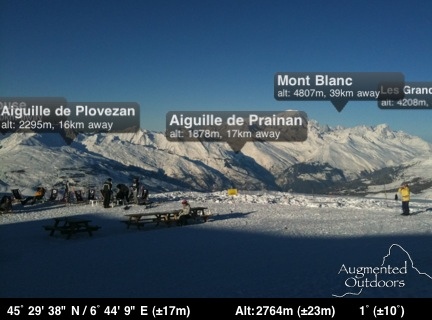
Image: Mont Blanc with “Peaks” by Nick Ludlum on Flickr

Nick’s off skiing this week, but he posted this screengrab from his iPhone to Flickr, and it’s a really effective implementation of AR. It’s an app called Peaks that simply displays labels above visible mountain-tops. It’s a great implementation because the objects being augmented are so big, and so far away, that the jittery display you so often get from little objects, nearby, just isn’t a problem. A handful of peaks, neatly labelled, and not a ropey marker in site.

And finally: Matt B’s Otamatone arrived. It’s delightful. A musical toy that sounds and works much like a Stylophone: you press a contact-sensitive strip that maps to pitch, but it’s the rubber mouth of the character – that adds filtering and volume just like opening and closing your own mouth – that brings the whole thing to life. You can’t see someone playing with it and not laugh!

It’s a product by Maywa Denki, an artist makes musical toys and sells them as products; previous musical toys include the Knockman Family, all of which are worth your time watching as much of you can on Youtube.

And if you get your own Otamatone, and practice really hard, maybe you could play with some friends:

Week 240

A brand new studio, but it feels really quiet. Nick is on holiday for the week. Matt Jones was in New York participating in the Microsoft Research Social Computing Symposium earlier this week, which focussed on “city as platform.” He’s currently in San Francisco with Jack, who is also on the road, working with Bonnier and Kicker on the next stage of Mag+. That’ll start ramping up more for us next week. Jack was in the studio on Monday putting up shelves. There’s a lot to do to settle into a new space, but wow it’s such a treat. I feel like I can stretch out here. There’s three times the space, it’s warmer, and it’s bright.

Tom is in the studio this week. He’s working on Ashdown, our UK schools project with Channel 4/4iP. He’s been extracting grades from tens of thousands of school inspections so we can start displaying a measure of pupil well-being, among other things.

Matt B is also here, sitting a couple of desks to my right, just outside the room we call “New Statham” (don’t even ask). He’s working on Kendrick, and the idea there is to learn from our on-phone prototype to completely map out the every screen and final visual designs of the beta version of the app. (Kendrick is a collection of iPhone apps for language learning, and the core team on that is Nick and Matt.) There are some features we’re leaving out of the beta – such as the first-run experience – but otherwise it’s about beauty and polish. It’s looking lovely, but there’s a risk of some screens being a bit too polished in a Bang & Olufsen stand-offish kind of way. More popular and approachable, with maximum beauty!

And it was Kari Stewart’s first day as studio manager on Tuesday! She’s making an enormous difference already. There’s a lot of admin she’s picking up, and the big thing we’re tackling together is how to a. provide a view of capacity and activity of the studio coming up; and, b. track projects so that we can build up a record of how we’ve done on each — frankly how much each project costs.

So I’m wanting to focus on project accounting and management accounts in the next couple of months. Are long consultancy jobs really profitable, given they mean principals are out of the studio and unavailable for even ambient involvement in other projects during that time? Are we good at estimating? It’s a concern of mine that, as BERG grows and the number of concurrent projects increases, we could accidentally paint ourselves into a cash-flow corner. Management accounts are about building ways to make these things visible. The financial accounts, projections, weekly catch-ups and ad hoc notes have previously been more than enough… but not so much now, and definitely not in another 3 months. There’s one or two larger projects I want in, so we need to de-risk growth.

My sister works at a medium-sized civil engineering firm, and they grade their projects (A, B, or C) in three ways: how profitable it was; how easy the client was to work with and how much they enjoyed the project; its strategic importance. I’d like to be able to do something similar.

And how can all of this be done with the minimum of overhead, and without distorting or risking what is a super pleasant working environment? I’m not keen on rules or explicit processes. I believe this kind of structure has to be thought of ecologically — how can it be included such that supporting it is still the easiest way to work, and that it naturally encourages good decisions without being an imposition, in the ecology of the studio itself?

A simple example, previously, has been putting the new work pipeline on the wall, and updating it every week. I’ve not pasted it up in the new studio yet, and that’s a problem. But just its presence kept us thinking about keeping the pipeline healthy and moving. So that’s the sort of thing I mean. But this is potentially a lot more heavy-weight, so I need to move with consideration.

I’m still learning what kind of tools are good for these needs, and really still figuring out what our needs are. But that’s the big picture of what Kari and I will be working on, in addition to the day-to-day studio life-support systems. Given that, I’m really curious to know what other people use for planning and tracking, so I’ve been asking around, and spotting other people’s work practices is one of the reasons I like reading weeknotes. Your own comments and thoughts are very welcome!

So that’s my week, in a nut-shell. I’ve been able to be much more involved with Tom and Ashdown, and Matt B and Kendrick, and I’ve really enjoyed that, and there’s a whole bunch of meetings and talking on the phone. I get to show off the new space and recent work, so it’s all good stuff.

Week 239

It’s the first week back of the new year and it’s taken me until Friday night to write this post. We have begun the new year both in a new studio, and in medias res.

Sorry, that’s kind of fancy. I mean we are in the midst of things.

Straight away.

Ashdown hit alpha before Christmas and we’ve learnt a load. So Matt Brown is working on combining our learnings with the research Georgina Voss did, and figuring out the information architecture for the beta (which we hope will be public, and we’ll be building this over the next couple of months).

And Kendrick, while we all had a software build with which to teach ourselves Italian over the Christmas break, Nick Ludlam’s piled right back into development, and Matt B has come right back into designs for the next milestone.

You’ll have seen Matt’s name there twice. He is busy. It’s unfortunate that so much falls on him the first two weeks of 2010, but it seems unavoidable and so we scheduled this fortnight pretty carefully this time last month. Fortunately he’s more than up to it.

Matt Jones and Jack are in San Francisco with Bonnier next week. This week Jack has been putting together our bit of the new studio (shelves! Coat hooks!), and Matt has been working with Bonnier and following up exciting new possibilities with exciting new possible clients. There’s a lot that backs up when the studio closes for two weeks.

Tom Armitage has been incorporating Ben Griffith’s work on Ashdown, and building up robustness for the site ahead of the beta.

I’m ticking over. Chipping in on games ideas for Kendrick. Meeting and going over both detail and Ashdown strategy with Dan Heaf and Tom Loosemore, our investors from 4iP. Working with Darq to get our IT infrastructure back up. Book-keeping. I prepped the accounts for this last quarter’s VAT return in record time, so I can work on that with Kari Stewart, our new studio manager who starts on Tuesday.

But mainly I’m concerned that everyone is happy. The first week back after new year is tough. It’s like dropping suddenly onto a bike halfway up a hill and you just need to right away change down a gear and grit your teeth, push hard and keep pushing, or into a spaceship that is already going at a quarter light-speed through the asteroid belt. Like, there’s no ramping up. Projects are underway. Negotiations are on-going. We’re owed a lot and we owe a lot, fortunately more the former than the latter. There you are.

Monday was enthusiastic. Wolfish!

Wednesday evening, for me at least, well I was knackered. It felt like a Friday.

Hello 2010. And now it is Friday.

So we’re right back in the middle of things, blinking and startled, sharing a brand new studio with our best, most talented friends, and when one of us says phew there’s a need to acknowledge that and say yes, there it is, good work fella, now let’s change down and dig in.

Phew.

Yes.

Change down, and dig in.

Tuesday Links: Drawings, Diagrams, Drawing Machines

A long while without links: I blame December deadlines and moving studio. A shame, given we’d been collecting a whole series of links on the studio mailing list; time to rectify that by sharing them with you, starting with a selection of articles connected by the theme of drawing.

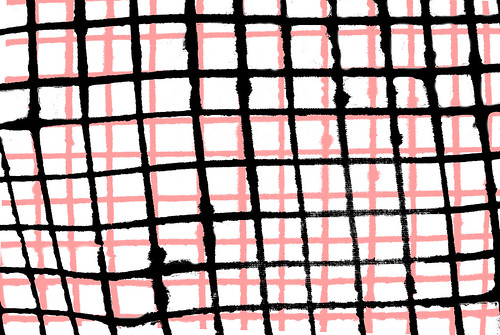
Hand grid with guide grid by atduskgreg on Flickr

Melt Triptych – Center Portrait from Peter Esveld on Vimeo.

Drawing Machines 2009 – the blog that kicked off the idea for this post, which we found after they linked to our little Inductive Truck prototype.

Accompanying a Fall 2009 class at ITP, the blog is full of links to all sorts of automated and programattic drawing devices, as well as examples of final work. I particularly liked Greg Borenstein’s post on drawing grids distorted by gravity, in an attempt to make visible the weight of objects, and enjoyed Peter Esveld’s Melt Triptych (also above) a lot.

DAM.11453.xg9qe.De.2.jpg
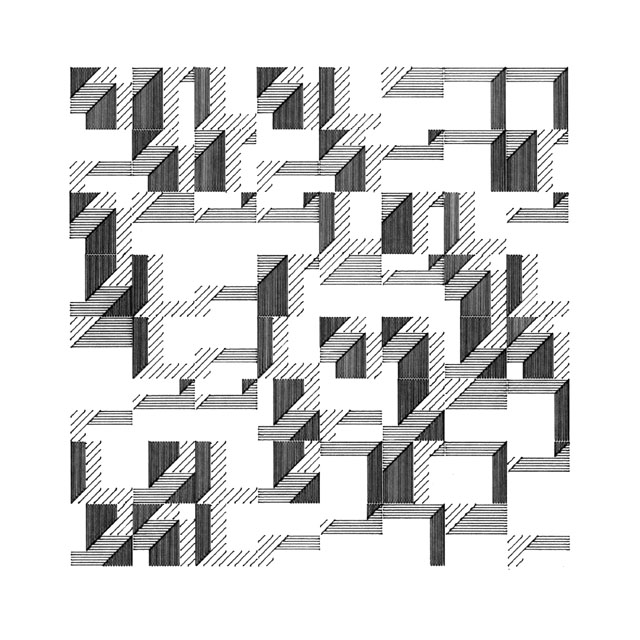
Edward Zajec ram2/9 plotter drawing 1969

A lovely selection of plotter drawings from the 1960s – a very early example of artwork created entirely digitally, with a surprising variety of styles on display.

And how about this: the Great Diagrams in Anthropology, Linguistics, & Social Theory pool over on Flickr, full of diagrams of linguistic constructions, social spaces, Polynesian tattoos, and suchlike. Exciting.

cybernetic_serendipity.jpg

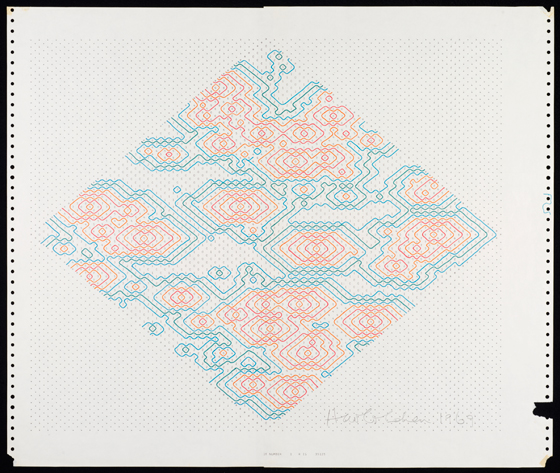
Untitled, Computer print-out with coloured pen and ink, Harold Cohen, 1969, from the V&A collection

And we – we being BERG – can’t talk about computer art without reference to Cybernetic Serendipity, the 1968 exhibition of computer art originally shown at the ICA. There’s a nice overview of it – and its importance – at the ICA website, and also in these original descriptions from its curator, Jasia Reichardt.

The Harold Cohen above is a lovely sample of it – its gridded pattern of cursive loops remind me a little of the distortion patterns Matt was playing with a while back.

Recent Posts

Popular Tags