Blog posts from February 2010

Week 246

Projects progress. There are many people working on El Morro, which has become a number of streams; Ashdown is finding its identity as a marketable product; Kendrick is closing in on launch; Trumbull has a product description and a design/development timeline; Service+ is wrapping up; and there’s some short consultancy in Germany next week.

Processes are being developed. Weekly updates for individuals and projects are put on the wall where everyone can see them. Projects are better accounted. I’m seeing gaps where processes would make life easier (induction; briefing docs; rolling project reports). Standard employee and supplier contracts are being drafted.

New work is coming in. The options continue to get more exciting, and allow for bootstrapping new parts of the business in ways that are only just beginning to come into view.

This is what metamorphosis feels like.

But we’re all working too hard and, though exhilarating – and, for the time being, worthwhile – the tiredness is showing. For myself, I can see important questions I’m not giving enough consideration, tasks that need doing, and opportunities I’m letting slip. This weekend I’ve felt like a zombie. I haven’t managed to get the work done I need to get done. It’s only 9pm on Sunday and I’ll go to bed shortly.

Any other week, the week just gone was so incredible I’d be wide-eyed and bouncing off the walls.

To the studio as a whole, what can I say? The work we’re doing – you’re doing – is beautiful, intricate, and unique. It’s a joy to be part of, and to see this team meshing so well: I look and I listen, and I see people taking responsibility, bringing things to life, working together, and so flawlessly. And I recognise that here, in the middle of things, it’s a lot and it’s rushed and it’s tiring. I don’t know what I can say about that. Other than, I guess, it’s on my mind, it has my attention, I want to figure it out. I’m proud of you and I’m proud of the work. I’m going to speak for Jack and Matt J too here: we recognise and appreciate it.

Timelapse

Timo Arnall has been working with us in the studio this week.

He made this. It’s super lovely.

Bigger here. Thank you Timo!

Links: Fashiony and Tiny and Making Do

Over lunch on Thursday, Russell showed us his S2H Replay – a really simple “activity monitor/pedometer thing“. I really liked his post about it earlier in the week:

it feels way more like the future than the fitbit because it’s cheap, fashiony and simple.

The Replay is $20. It doesn’t need any connectivity to share your fitness scores – a code appears on the Replay’s screen and you type it into the S2H website. It makes a smiley face when you’ve done enough exercise. And that rubber bracelet is clearly designed to be replaced/customised/given away as a freebie.

Russell’s post has lots more detail and insight. As well as the device, I liked Russell’s use of “fashiony” as a watchword: something that feels fun and now and a little bit pop. Or to use a metaphor: the Replay isn’t Ikea, it’s American Apparel. For something like the Replay, I think that’s a good quality to have.

Makedo looks like a fun take on construction toys: “a set of connectors for creating things from the stuff around you“. It’s a construction set made only of connectors and hinges; the raw materials are left for you to find. The video above has some good examples of its possibilities. My only doubt is if Makedo is toy-ish enough; the website makes it seem targeted more to an older, crafting audience. But there’s a charm and inventiveness in both the toy, and the play it enables, that I like, and I think that makes it worth a link. (Via Alice Taylor, who saw Makedo at the Toy Fair).

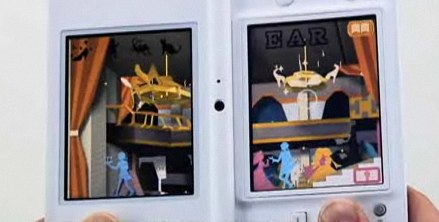
dsiware-game.jpg

I think this was my favourite thing I saw this week: a downloadable game for Nintendo’s DSi. The aim of the game is to find letters hidden in 3D scenes, styled a bit like a cardboard toy theatre, by tilting the device around. The video you need to see is the second one down on this page – I can’t embed it. It’s mindboggling: a game all about perspective and visual trickery, which looks utterly beautiful. Even more impressively: the DSi has no accelerometer, just two 640×480 cameras – so all that movement is being calculated through motion tracking.

I was mainly taken with how beautiful it was, though. The only sad thing: I don’t read Japanese, I have no idea what it’s called. I hope it comes out in the English-speaking world soon.

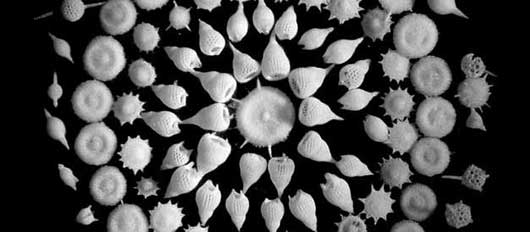
radiolarians.jpg

Image: taken from Amos Topping’s slide of Radiolarians

Anne Galloway linked to this great SEED slideshow of Victorian Microscope Slides.

Some beautiful images here, but also a fascinating juxtaposition of scientific marvel – “tiny objects now made visible” – with aesthetics – “tiny objects arranged beautifully“. (Anne’s original post; the collector Howard Lynk’s own website)

Finally: scratching and drumming with a set of holographic heads. (via Scott Beale). This is a live performance of Chris Cairns’ Neurosonics Audiomedical Labs inc, and elevates it from “nifty video effects” to something far more ingenious. It made me laugh, too.

Week 245

It’s one of those weeks where I find it hard to remember what’s happened.

Jack and Matt J are in San Francisco, so there have been a lot of Skype calls between us.

Timo is here too, working on El Morro. He’s sitting in the second room which is called Statham. Campbell is in Statham too. He was sitting at Jack’s desk which is next to, and at right angles to mine, but changed yesterday. Nick is sitting at Jack’s desk. At Nick’s old desk is James who started Thursday. Bringing James in at this point was perfect timing. His presence is a forcing move to the project specification being refined, clarified, and better explained.

James is sitting opposite Tom. To the right of James and to the left of Tom is a sofa from Muji. On the sofa from Muji are two desks from Unto This Last partially assembled. These desks are half as long again as the ones at which James and Tom are sitting, and will replace those desks this afternoon. One of the old shorter desks will go into Statham. The other will go into the shared meeting room.

To the right of Tom is Matt B. He hasn’t moved. Opposite Matt B is Matt J’s desk which cannot be occupied. It is piled with books and files and whatnot, all of which used to be underneath the desk. But on Tuesday the studio flooded, and so the rest of the week has been punctuated by gurglings from the plug of the sink (which is where the water came from), and negotiations between the landlord and Tom Taylor, with whom we share. There’s going to be a pump and pipe put in so the sink leads to a separate drainage point. The current drainage point also has a feed from the roof so when it rains and the drain is blocked, our sink is the water’s only means of egress.

“Egress” sounds like the name of a sea bird.

During the development of Shownar, this time last year, we found ourselves having to refer very precisely to weird abstract concepts that arose from the data. To have conversations without misunderstandings, we made up words and put a long dictionary on the wall with the title “Teach yourself Dutch.” Because for some reason the project lingo got called Dutch.

It’s not really Dutch. It’s English. But to an English speaker listening in on us talking in this lingo, it wouldn’t be comprehensible.

El Morro has its own Dutch. Dutch, the project lingo, is never just a shorthand. It expresses things that, eventually, cannot be fully expressed in regular English. It ends up having its own grammar, and members of the team end up having to become fluent speakers of it.

In El Morro, a good part of Dutch – the dictionary, if you like – is defined in a spec which is 11 pages long. Timo is learning how to speak Dutch, and practises every day. Whereas we’ve written the dictionary, he’s inventing the idioms. He might need new words, in which case we’ll revise the dictionary. It’s funny, this process of inventing Dutch, because in a few weeks we’ll have a much larger team and everyone will need to speak it. It’ll start to carry meanings of its own, and its structure will encourage particular kinds of new Dutch poetry, poetry that we never imagined.

When I speak about ecological management, this is one of the things I mean. The invention of the right kind of Dutch can steer the project creatively without explicit directing. Just as the ambient knowledge and visibility of studio activity helps people operate with autonomy and agency with respect to running and selling projects. I’m not great at ecological management yet, but it’s the star by which I measure myself.

It is after lunch.

We have now assembled the new desks and everyone and everything has moved around. There are eleven seats in the studio. We have run out of the good chairs again.

Week 244

It’s Saturday and I’m at my kitchen table with a cup of tea. I enjoy working Saturdays so long as they’re optional. So far I’ve sketched the latest rev of an XML specification, drawn a cartoon of a workflow and written a commentary on it, replied to a few emails (though I’m still way behind), and checked the accounts.

My attention this week has been dominated by El Morro. It’s larger than we’re used to both technically and with regard to personnel, so the usual processes need to be re-invented. For instance, we need to be more formal with documenting issues, working decisions, and goals. In terms of people: Jack and Timo are in New York, and next week Jack and Matt J will be in San Francisco. Nick is wrapping Kendrick soon to move onto El Morro, Tom’s attention is going to be divided from Ashdown, and we’re extremely pleased to have two new team members for this project. James Darling starts Thursday, and Phil Gyford is with us again for the next two weeks to help springboard. As Campbell finishes with Service+, he’ll also join the team. And we’re still looking for an iPhone developer. We’re based in London, working alongside teams in Stockholm, San Francisco, and New York.

It’s complex. But we thought carefully and planned tightly before taking it on, so it’s doable. You have to trust your boots. It’s the possibility of collateral damage that I feel the need to de-risk.

For instance: Kendrick is drawing, beautifully, to a close (over the next month), and the last week has seen a new focus and a kind of “coming into focus” for Ashdown. Matt B, Tom and Nick have their hands full with both, but with the attention of principals so divided, I’m concerned that studio attention might drift too. So that’s a way that processes break during growth: our old ways of managing projects aren’t as effective anymore, and we need to find new methods. A kind of growing up. I’ve got a few ideas, but I plan to open the discussion with the team on Monday.

Hang on, let me get a glass of water.

Back.

It’s like the accounts. The shift to a new system and my financial projections worked for maybe two months, and now growth means they’re broken again. Jack asked me on Monday night last week some questions I couldn’t answer. So on Tuesday I put together new templates for analysing per-project profit and loss, and creating per-project budgets that feed into an overall studio budget. It’s finer grained than I had before, and it’ll create new jobs for Kari, but necessary and fascinating. Imagine building a boat while you’re standing on it. One minute you’re building fishing rods and oars, the next you’re creating a rota to monitor for driftwood, and the next month you’re figuring out how to feed the R&D group you’ve delegated to invent radar.

A minute only ever lasts a minute. Hard work and efficiency only gets you so far. What you put in the minute has to adapt.

Now my mind turns to what growth is for. That’s been the subject of several conversations recently because Scenario 4 is hard, and we all need to know it means something. Well we’ve always had a product business in mind: beautiful, inventive, popular products for the home, ones that make solid our design and technical beliefs, that make the everyday more joyful and humane. Products that couldn’t come from anyone but us. So there’s that. And previously I’d been focused on building the right team with the right expertise and capacities for such a moonshot. But we’re there almost there. The studio is a machine humming and waiting for just such a challenge to take on together. And so now my mind is turning to bootstrapping in a less abstract way, and using the time these current projects buy as the means to plan more direct steps.

Ha! I’m listening to iTunes on shuffle, and a track from A Momentary Lapse in Reason by Pink Floyd has come on. This was playing when I got my first modem in 1994, and went online from my own computer for the first time. That is half my life away.

Let me wrap up.

It’s a big moment for us when friends who have worked on a particular project decide to join us on an ongoing basis, whether it’s for a couple of months or for much longer. When somebody is part of the studio and contributing to any and all projects, that means they become part of the creative life of BERG. They contribute to – and have taken personal responsibility for – its culture, its creative direction, its work, and its instincts.

At the drinks we hosted on Wednesday, celebrating Deep Blue’s victory over Garry Kasparov in 1996, I didn’t do my usual “talk nonsense for 5 minutes,” but instead called out the people who make up BERG, here in Scenario 4 and week 244.

So I want to do the same right now, because it’s a huge deal that we’re all in the same room together, doing this thing together, and saying it out loud to you here is the best way I can think of to show how I feel that.

Jack Schulze! Matt Jones! Tom Armitage! Matt Brown! Nick Ludlam! Kari Stewart! Campbell Orme!

What a team!

Thursday Links: a bit of colour around the place

There’s lots of text on the blog at the moment. Time to add a little bit of colour with some links that have been floating around the studio.

goldenhook.jpg

Following last week’s link to Reknit, friend-of-BERG Rod McLaren gave me a link to Goldenhook. It’s a French business selling knitted goods with a twist:

Golden Hook is an innovative fashion brand which allows you to create made-to-order beanies by choosing your beanie style, material, and color. You also choose the authentic grandmother who will knit your beanie from our gallery of grandma photos.

Authenticity being sold through choice – and a personal connection to whoever’s knitting your new hat. Fun, although if Goldenhook is anything to go by, Granufacture isn’t very cheap yet.

sausagefingers.jpg Meanwhile, from Kottke – and a great many other sites – comes news of increased sales of miniature sausages in Korea:

Sales of CJ Corporation’s snack sausages are on the increase in South Korea because of the cold weather; they are useful as a meat stylus for those who don’t want to take off their gloves to use their iPhones.

Meat styluses. I really have no sense for the Korean market: might this be a hoax? No idea; it doesn’t seem so, given the coverage. And it definitely works, as this video of someone playing Taiko Drum Master with a pair of sausages demonstrates. That’s one way to keep your fingers warm.

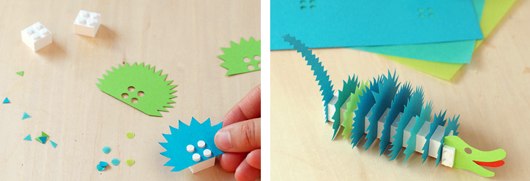
mujilego.jpg

Matt Jones sent this to the studio mailing list last week, and it was destined for the blog from the get-go: a beautiful collaboration between Lego and MUJI Japan. It’s so simple: a model made out of a combination of Lego pieces and what look like origami squares, with pre-punched holes for joining the paper to the bricks. And: what a cheery crocodile.

Finally, via our frequent collaborator Timo Arnall comes a striking depiction of one potential Augmented future, courtesy of Keiichi Matsuda. Matsuda writes:

The latter half of the 20th century saw the built environment merged with media space, and architecture taking on new roles related to branding, image and consumerism. Augmented reality may recontextualise the functions of consumerism and architecture, and change in the way in which we operate within it.

In his video, the home becomes another space for being advertised to in – with the catch that the more advertising you choose to be subjected to, the more revenue you’ll generate. The glitches in the AR system, and the horrible Girl From Ipanema cover are the icing on an entertaining (if somewhat bleak) cake.

Week 243

It is 6.30 pm in a foreign city and I have taken five minutes to write this note. Jack, Matt J and I are with clients in a workshop that began Saturday noon, after waking to leave London earlier than 5 am, and it will continue until Monday night. Over the last week, nobody in the studio was working any less hard than this. It is tiring and the work is good. I genuinely can’t remember week 243 enough to summarise nor reflect on it. This moment, sat on the windowsill with my laptop on my lap, drawing interfaces and technical architectures in red felt tip pen, cutting paper and covering walls, writing rules that will govern us for weeks or more to come, this is the only moment, the legitimacy of kings is written in blood, and this is the reality of life in Scenario 4.

Hiring developers!

I’m currently looking for two developers for some iPhone work, and my usual networks have run dry. Here’s who I’m after:

iPhone developer. Great knowledge of iPhone APIs and developing. There’s a lot of UI and network activity with this app, so you’ll need to be rigorous to identify and catch possible failure modes to keep everything smooth. As ever, awesome user experience is what we’re after, so you’ll be working closely with experienced designers and an incredible lead architect and developer, and you’ll need to translate conversations and requirements into solid, beautiful code. You’ll need to learn fast.

Back-end developer. There are multiple servers that support this app, all interacting with one another. So you’ll need a good eye for Web services, both designing and implementing the protocols. Scaling and robustness are key, so you’ll be able to make a judgement about what we need and get the right solution. You’ll probably work with Rails, since this system is patterned on one we’ve just developed and we’d like to build on the same effort. You’ll need to go all the way from setting up staging and production servers and databases, to tools for deployment and ops, to rough and ready client-facing front-ends for managing content.

What I’ll be looking for, in both roles is…

  • experience. Have you done this before? We need to get this right with the minimum of iteration. Show me what you’ve done: we love working with people better than us.
  • London-based. We work better when we sit together. You’ll spend at least half your time in a small but busy design studio, with multiple big projects and certain kind of culture… you can get a picture of that from the weeknotes.
  • responsibility and team-work. You’ll need to take ownership of challenges and come up with solutions before other people even notice, and communicate and listen constantly so we’re all playing well together.

It’s short notice: starting in a week or so, for a two month contract.

Know anyone like this? Please pass this on!

Is this you? Get in touch! I’d like to be speaking with candidates late on Monday 8th, so drop me a line by the end of the weekend: mw@berglondon.com.

Maps and macroscopes

I wrote this article for Scroll Magazine in October 2009, to coincide with my Web Directions keynote, Escalante. It builds on the themes in my June 2009 talk, Scope. The piece is now online here but it’s always nice to have a record on your own site so here it is! And go pick grab yourself a copy of Scroll. It’s a lovely, lovely mag.

Richard Feynman, the 20th century American physicist, was once challenged by an artist friend as to whether a scientist could see the beauty in a flower: “You take this all apart and it becomes a dull thing.”

Feynman worked on the atomic bomb and developed the theory of quantum chromodynamics. He didn’t agree.

“I could imagine the cells in there, the complicated actions inside which also have a beauty,” he said in an interview, telling the story of his response. “I mean it’s not just beauty at this dimension of one centimetre, there is also beauty at a smaller dimension, the inner structure. Also the processes, the fact that the colours in the flower evolved in order to attract insects to pollinate it is interesting – it means that insects can see the colour. It adds a question: Does this aesthetic sense also exist in the lower forms? Why is it aesthetic? All kinds of interesting questions which shows that science knowledge only adds to the excitement and mystery and the awe of a flower. It only adds; I don’t understand how it subtracts.”

In addition to being a physicist, Richard Feynman is (sadly: was) one of the very few, very great explainers.

This double view of a flower doesn’t fixate on its beauty. When you see two scales simultaneously – the flower in your hand; the atoms and processes of nature at a global scale – your consciousness ricochets between them, producing awe and enlightenment both. Maybe Feynman’s story resonates particularly for me. I was trained in physics.

Stewart Brand, pivotal in the creation of the earliest electronic communities and the culture of the Internet, is another hero of mine. He’s both a connector and explainer. In 1966 he started a movement in San Francisco, distributing buttons with the message, ‘why haven’t we seen a photograph of the whole Earth yet?’ He campaigned for Nasa to turn its cameras back on the planet and show it to us, laid out.

In the early 1970s Nasa obliged and published the Blue Marble photo. You will have seen it: the Earth hangs as a crystal sphere of white, blue and precarious brown, alone in a black cosmos.

You see yourself and the planet all at once, two perspectives overlaid. We’re hardened to such images now and it’s tough to imagine what it was like, a generation ago, to have the God’s eye view of the Blue Marble for the first time.

Brand later spoke about why he’d campaigned. “People act as if the earth is flat, when in reality it is spherical and extremely finite, and until we learn to treat it as a finite thing, we will never get civilization right.”

Feynman’s flower and Brand’s whole Earth are, to me, scientific instruments. Biologists have microscopes. Astronomers and peeping toms have telescopes. The instruments we have here, to use the designer John Thackera’s term, are macroscopes.

Thackara gives a definition: “A macroscope is something that helps us see what the aggregation of many small actions looks like when added together.”

A macroscope will focus ideas as a microscope focuses light. It’s a tool for the designer. A designer’s job is not only to fulfil their craft, in graphics, or furniture, or silver or whatever it may be. And it’s not only to understand all kinds of context and produce objects that are aesthetically and functionally pleasing. A designer’s job is also to invent culture.

I make that addition, to the designer job specification, prompted by my business partner Jack Schulze. In a recent interview he attacked the view that design is about solving problems: “Obviously designers do solve problems, but then so do dentists. Design is about cultural invention.”

Schulze points out this feature of design because otherwise design is not distinguishable from others of the many processes of creation. Great products can come out of processes such as ethnography, market analysis, opportunistic use of the cheap products of the Chinese manufacturing industry, and luck. Design is but one approach. Design’s differentiation, says Schulze – and I concur – is its obligation to participate in and invent the world. There is an obligation for designers to push culture forward, and because of that, to be relevant.

Since I’m being pedantic about the definition of design, I could easily be as pedantic about the definition of culture. Happily Bruno Munari, Italian designer and author of “Design as Art,” supplies a working definition of “culture” which is both adequate and profound. Culture, he says, is “the things that make life interesting.”

But the world is changing at pace and at scale. To remain relevant, let alone interesting, is a struggle if culture is too large and too broad to apprehend. Take, for example, the global financial system, which in late 2008 and early 2009 almost collapsed and took civilization with it. The cleverest people in the world – the cleverest people by any measure you can name – cannot tell a cohesive story about the near collapse of the banks. We can’t say why it happened. It is too big to see.

Why haven’t we seen a photograph of the whole financial system yet?

To see the banks and, by extension, all of culture on a human scale, we need a special sort of instrument: a macroscope. A macroscope could show us the personal effect of debt and finance on a human scale, and the globalised system together. It would help us make connections and to make human connection. And from there, act.

Such an ability to feel the human scale and the grand view all at once seems like a superpower. Recently, at BERG, we attempted to visualise this superpower as it would change the way you navigated a city, the urban environment being the archetypal human creation which is lived in but also too large to comprehend.

The result is a new kind of map projection, and a map of Manhattan named “Here & There.” The projection warps the city grid, showing the top-down and street view in one. Now, looking over conventional photos of the New York skyline, I notice the absence of my new power to see here and spy there together, and being able to plot a path between them.

A macroscope of the banks would have the long zoom power of Feynman’s point of view of a flower, and the visual clarity of the map of Manhattan.

I believe our job is the creation of Here & Theres for all sorts of matters of cultural importance. Macroscopes give all of us sight of our place in the world, and the power to participate in it; and, as designers, they help us understand culture more directly, in order – ultimately, and simply – to better engage in our craft with integrity and relevance.

Weekly(ish) links: Knitting, Indium, and introducing AR through advertising

Last week’s links slipped over into this week’s. If you read Matt’s weeknotes for last week – week 242 – you can probably understand why. But! Better to be late than to forget them.

reknit.png

I loved Reknit: a site for turning unwanted woolen goods into new products. You send off an unwanted pullover, it gets unravelled, and sent back to you as something new. This month, it’s a scarf; next month, you’ll get something else based on a vote (in the running: a beanie, iPod case, cut-off gloves, or socks). If you don’t have a sweater to recycle, the site even offers to find you your nearest Goodwill store, where you can no doubt buy many new, old, scarves. This isn’t a large-scale industry, though; it’s the creator’s mother. And that’s the bit I really love, encapsulated in its tag line: this month, my mom will turn your old x into a new y. It won’t ever be a big operation, but it opens up her knitting to a slightly wider audience than the rest of her family. Lovely. Matt Brown coined something similar in the studio last week: small scale Gran-ufacture.

years-left.png

On a slightly more sombre note, Matt Jones sent this image to the studio mailing list, from a 2007 New Scientist article on the depletion of Earth’s natural resources. The stat that really caught our eye was the dwindling resources of Indium. Indium’s a critical component of LCD displays, and whilst, obviously, other screen technologies are available – and will continue to be developed – Matt noted that it’s a reminder that non-screen-based interactions (like those in Availabot or made possible through RFID) have an environmental value as well as a technological one.

Fauxgmented Reality

The picture on the right is an advert I saw on the tube last week, for the University of East London. We write a lot about Augmented Reality on the blog, but I always assume we’re coming from a technologically informed/privileged position. So when I saw this on the tube, I did a double take; this is a faux-AR image of the Thames, with UEL facilities and landmarks picked out not only by map-pins, but also glassy iPhone-style bubbles. Perhaps the point of reference is meant to be mapping, but the combination of the popups with the photograph feels exactly like AR to me; the idea that AR was already a usable metaphor for advertising was very surprising. It’s also a reminder of the ability advertising has to introduce new concepts, rather than just illustrate old ones.

It’s not all serious links about Augmented Reality, or the Earth’s dwindling resources, on the studio mailing list, though; there’s also a decent amount of “here, look at this!“. It’s alright to like pretty things. I found this video from friend-of-BERG Alex Jarvis, and just had to share it. Ingenious animation, beautiful sketching; seems like the right thing to end these links with.

Recent Posts

Popular Tags