This website is now archived. To find out what BERG did next, go to www.bergcloud.com.

Blog posts from 2012

“Companion Species” in Icon’s special edition on Mobile Phones

Icon #106

Will Wiles, the Deputy Editor of the design magazine Icon, asked us recently to contribute to a special issue on Mobiles Phones alongside James Bridle, Kazys Varnelis, Marko Ahtisaari and Will Self, among others.

I wrote a short piece on smartphones as ‘companion species’, that reflects a lot of ongoing themes and discussions in the studio around designing the behaviour of sensate devices with ‘fractional intelligence‘.

They see the world differently to us, picking up on things we miss.

They adapt to us, our routines. They look to us for attention, guidance and sustenance. We imagine what they are thinking, and vice-versa.

Dogs? Or smartphones?

Mobile devices (can we still call them phones?) are being packed full of sensors, processing power. They are animated by ever-more-sophisticated software, dedicated to understanding the world around them (in terms of advances in computer vision and context-awareness) and understanding us (speech recognition and adaptive ‘agent’ software such as Apple’s ‘Siri’)

They are moving – somewhat awkwardly – from being our tools to becoming our newest companion species.

Donna Haraway, theorist on our transformation into cyborgs, published ‘The Companion Species Manifesto’ in 2003. It addresses the relationship between domestic dogs and humans, but there is much in there to inspire designers of smartphones, apps and agents.

“Cyborgs and companion species each bring together the human and non-human, the organic and technological, carbon and silicon, freedom and structure, history and myth, the rich and the poor, the state and the subject, diversity and depletion, modernity and postmodernity, and nature and culture in unexpected ways.”

Using inspirations from theory such as Haraway, and fiction – such as Philip Pullman’s ‘Daemons’ from his ‘Dark Materials’ books – we can perhaps imagine a near-future that is richer and weirder than the current share-everything-all-the-time/total-gamified-personal-productivity obsessions of silicon valley.

A future of digital daemons would be one of close relationships with software that learned and acted intuitively – perhaps inscrutably at first, but with a maxim of ‘do no harm, with maximum charm’.

Intel’s Genevieve Bell recently spoke of the importance of designing relationships with – and crucially, between our technologies – so that we not in the centre of an arms-race of ever-more-complex 1-to-1 interactions with our phones, tablets and apps. She memorably quoted a research subject that likened her collection of digital devices to a ‘needy backpack of baby birds’

Much better to have one faithful, puppy-smart daemon device, working at our side to round everything (and every thing) up and relate what it senses to us?

At BERG we are fond of quoting MIT roboticist Rodney Brooks – who said that fifty years of sustained work by the brightest and the best in artificial intelligence would get us things that were ‘smart as puppies’ if we’re lucky.

This seems like a fine goal to us, rather than creating uncanny, flawed and frustrating analogues of human intelligence and interactions – such as Siri, or if we cast our minds back a decade – Microsoft’s ‘Clippy’.

This future might also free the form of our devices – from glowing rectangles that suck our attention from the world, to subtler physical avatars representing our companions – things that listen, watch, speak – to us and for us.

Our companion species as are likely to inhabit the biomimetic descendants of the Nike fuelband or the now-mundane bluetooth headsets as Ive’s perfectionist slabs of glass and alloy.

Also, companion species might be shared, as a family pet is now – bound to home and hearth rather than the predominant 1-to-1 ‘personal computing’ paradigm of the last 40 years or so.

What forms might these ‘household spirits’ take? Nest’s smart thermostat has pursued the Ives/Rams route of tasteful (if ironically, cold) elegance, whereas our own Little Printer takes a rather different approach…

There will be more diverse responses to these new categories of digital/physical extensions to ourselves, our homes, cars and cities. Which is as it should be.

I hope it triggers explosion of form and interaction beyond the glowing touchscreen hegemony. The advent of ‘digital companion species’ should be a cambrian moment for design.
Friday links

It’s Friday, and this is being hastily penned after a particularly good Friday Demos, so here we go!

Alice linked to this explanation of Sim City’s new simulation engine.

Alex has been having fun with Flixel, and sent us all this image.

Denise sent us all a link to this, simply saying “The sound of the Internet. Lovely piece by Giles”.

I sent a link through to yet another amazing Boston Dynamics robot in the making.

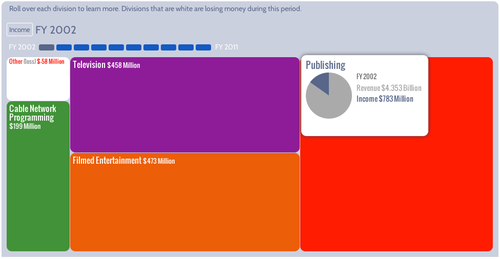
Matt Jones linked to a PBS article which details where News Corp makes its money, which also ties in nicely with the recent Panorama documentary on Pay TV hacking in the UK.

Where does News Corp generate its money?

We’re wrapping things up in the studio after an impromptu Youtube party, and are off for a well deserved pint. Have a good weekend!

Week 355

It’s a relatively quiet week, with a number of people out of the studio either engaged on client work, or simply working remotely. Those of us here have continued to bask in the sunshine streaming though our gigantic roof windows.

Andy has been chasing suppliers, partners and manufacturers, as well as working with me on joining up computer code with actual electrons in wires. I’ve cryptically written the phrase “COCO POPS” next to his name in my notebook, but what that means is anyone’s guess. Tuesday feels like such a long time ago.

Alex, James and Alice have all been splitting their efforts between Chuska and Little Printer. Within LP, Alex is working on website and packaging designs, James is bringing the website designs to life, and Alice is implementing interfaces that will enable us to maintain all the aspects of BERG Cloud in good order.

Helen is balancing the straight-forward world of tax payments with the exciting, nondeterministic world of predicting when invoices get paid, allowing us to avert problems before they’ve even happened.

Denise is also working on LP packaging, as well as some super secret design work which she’ll reveal at a later point in time.

Timo is working on project Silverton from an undisclosed location deep in the Italian countryside, and his occasional instagrams are making us all very jealous.

Matt Jones, Matt Webb and Joe are out of the studio, working on the newly initiated project Sinawava, and Simon and Vanessa have been writing proposals for future studio work. Good future grist for our studio mill.

Lastly, I’ve been writing cryptographic hashing functions, and enjoying a tiny lemon meringue pie sold by our favorite purveyor of caffeinated beverages, Giddy Up Coffee. If you find yourself in the Old Street area of London, I highly recommend them!

Walk the Marianas Trench!

Hearty congratulations to James Cameron on reaching the bottom of the ocean at the Marianas Trench.

If you’re not a millionaire film director with cutting-edge tech, then you can still experience the extreme distance he travelled with the site we developed with the BBC, HowBigReally.com

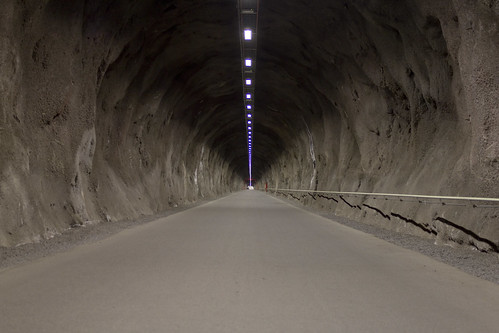
The walk from our studio

Enter your postcode and get an idea of how far the bottom of the Marianas Trench is from where you live… or even better, calculate a route to take a walk that’s the same distance as James Cameron travelled in his submersible!

In other Marianas Trench news… A Canadian band that goes by that name has a lead guitarist named Matt Webb…

Thursday Links

I am going for a bike ride in Kent tomorrow, so this is the state of my inbox as of the end of Thursday.

Timo shares “Warriors of the Net” -a video from the 1990’s that I am pretty sure I watched in an ICT lesson at school. It is probably the root cause of my deep seated fear of sysadmin, and anything lower down the TCP/IP stack than the application layer. Leave that stuff to the neck beards, I say. I do wish BERG videos had more gravel toned voice overs though.

It also has this natty website: http://www.warriorsofthe.net/about.html

Timo also shared Robin Sloan’s Fish. I had to borrow an iPhone to experience this, but it was well worth it. A lovely and thought provoking thing.

Stamen’s maps were also all over the web this week. Most impressive is the watercolour view, but I also really like the toner view.

Timo (again) shared this video from Nature and MIT about seeing round corners with lazers.


Denise shared these brilliant stereographic drawings: http://robotmafia.com/stereographic-drawings-by-dain-fagerholm/

Denise also shared this story about an author who has written software to automate writing sports reports. This is both pretty impressive AND gives me a great idea for Friday Links…

Week 354

Happy equinox! As the summer approaches and the sun appears more each day, patches of light are cast down through the skylights into the studio. Currently the light illuminates just the north wall and the table, meaning I was able to bask in it during our weekly meeting.

Following the requisite discussion of what the number 354 means, including some eye-rolling from me about how much time Mathematicians seem to spend finding and naming patterns in numbers that are seemingly of zero consequence, we proceed with what everyone is up to this week.

James, Alex and I are working on Chuska, a four week run at a short brief with sketches in code, and a lab notes style approach to working. We are also continuing work on Little Printer and BERG Cloud.

Matthew is focussing on business development.

Nick is writing software for Little Printer. I’m not sure I can be any more informative than that or the Infosec police will come for me in the night.

Andy is doing an awful lot, all Little Printer related. Chasing colour sheets to send to China, technical files for certification (Little Printer has some exams to sit), paper testing, spending time looking at Gantt charts with Simon, quotes, bombs, stepper motors.

Timo is rezzing concepts with Joe for Silverton. They are sat on the sofa right now chuckling and looking at gadgets that might be real things or might be models, I can’t tell from here. Timo is also completing some video sketches, and continuing his quest for the sales Steak Knife set.

Simon is massaging the starts of some projects and then ends of others. He is also managing Little Printer and our time around that.

Helen has finished a record stint of cake buying. There have been four birthdays in four weeks, each requiring a cake. This week she is helping Simon with POs and NDAs and setting up various profiles and passwords for our new team member.

Denise is doing a little project with Matt Jones, working with Tim on some Uinta stuff and managing all of the enquiries and comments we get from the many people whose attention Little Printer has grabbed.

Matt Jones is overseeing Chuska, working with Denise, doing some bits and pieces on Silverton and some preparation for Sinawava.

So that’s week 354.

Sunday links: CNC bots, parallel lines and Terry Wogan

From Nick, piccolo, the tiny CNC bot:

Piccolo the tiny CNC-bot from diatom studio on Vimeo.

From Denise, Dog Ear, a new publication on a bookmark by Fallon:

Dog Ear, by Fallon

From Alex, Synchromy – an animation by Norman McLaren from 1971 created by using an optical film printer:

From Timo, Intersections in the age of driverless cars. This gave me the willies.

Matt Jones shared this picture of a Hydroelectricity Plant, which reminded me of John Glen-era Bond movies:

Hydroelectricity Plant

James, like the rest of us, really like the new design of Fix My Street, especially the way it scales for different sizes of devices. Check out what needs doing near our studio.

From Jack, reaDIYmate – build an internet-connected thing in 10 minutes:

Shouts to @alruii for sharing Terry Wogan’s Secret Pirate Radio, brainchild of the marvellous Peter Serafinowicz:

Foxes and owls

Some more lovely character sketches by Denise for our Lamotte project, following on from her bears, sloths and rabbits…

More lovely character sketches by Denise

Week 353

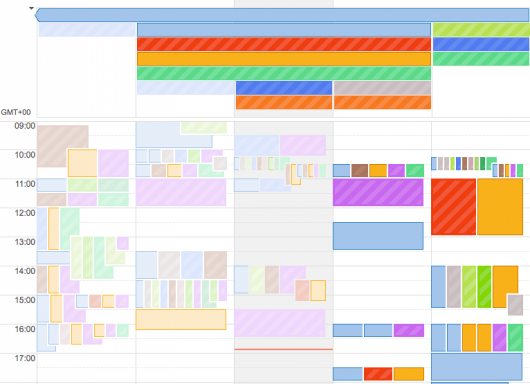
It’s 4:55pm on Wednesday, and this is my most frequent type of view on Week 353 – the week calendar. Most of what we’re up to is here. With all the minutiae removed, I wonder if it’s possible to guess who is who?

It just so happens that a number of client projects have recently finished or are wrapping up at the moment, at much the same time, and several new ones are kicking off. The processes around getting everything in place to start & finish are numerous and I’m running through my checklists to make sure everything is set up correctly. Helen’s been doing similar, arranging travel and keeping the finances in check.

Matt Jones, Timo and Joe are all involved in a kick-off workshop for Silverton this week and our clients are here with us. Today we can just about hear animated conversation coming from our meeting room. It’s the first time we’ve run a workshop in our new studio space, which we’ve well and truly settled into now. Matt Webb has been involved in this a bit too, alongside writing proposals for upcoming projects, making decisions about Little Printer and bringing delicious curry to the studio for lunch.

Alex has been furthering the packaging design for Little Printer, as well as producing assets for the next iteration of the remote site ready to be built. He’s also going to be leading a new project, Chuska, in the coming weeks with Alice and James, who are also working on publications and infrastructure for Little Printer and BERG Cloud. They’ve also been out and about filming with Timo for Lamotte, and making toast at 5pm, which makes the whole studio a bit peckish.

Denise has been drawing owls and foxes for Lamotte (for Timo, who will be making them fly) and generally steering the design and content of Little Printer.

When Andy isn’t strong-arming the studio into drinking coffee or eating doughnuts, he’s overseeing the tooling and production of the various parts that go into the physical Little Printer, tweaking electronics, ordering parts and lining up all the hoops we’ll be jumping through en-route to announcing pre-orders. He’s also been shouting numbers and letters that I don’t fully understand across the studio to Nick who’s been working fervently on immediate tweaks to the lower-level software on Little Printer, and working with Phil on the remaining functionality we want to implement.

Jack and Kari are both missed, although occasionally pictures of tiny humans who look a little like them are sent around the studio.

Last but not least, please let it be known that the number 353 is a double sexy prime – that is, the numbers which are six away on either side (347 and 359) are also primes. Ooh-err.

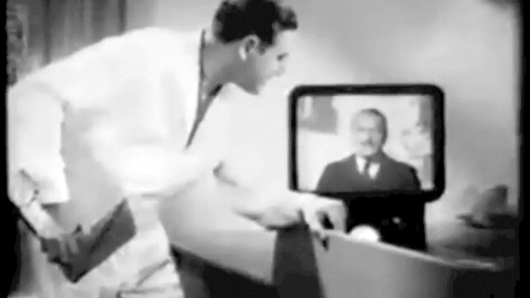
Notes on videophones in film

(It’s good at the beginning of projects to research what’s come before, and Joe is pretty spectacular at finding references and explaining what’s interesting about each one. He’s done this for a few projects now, but we’ve never made his research public. Last year Joe put together a set of appearances of videophones in film. It’s a lovely collection, and it was a stimulating way to think around the subject! So I asked him to share it here. -Matt W)

Metropolis (1927)

Features wall-mounted analogue videophone. Joh Fredersen appears to use four separate dials to arrive at the correct frequency for the call. Two assign the correct call location and two smaller ones provide fine video tuning. He then picks up a phone receiver with one hand and uses the other to tap a rhythm on a panel that is relayed to the other phone and displayed as flashes of light to attract attention.

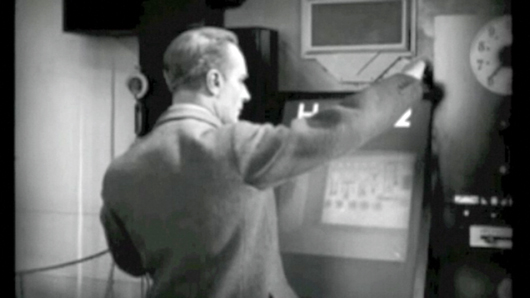
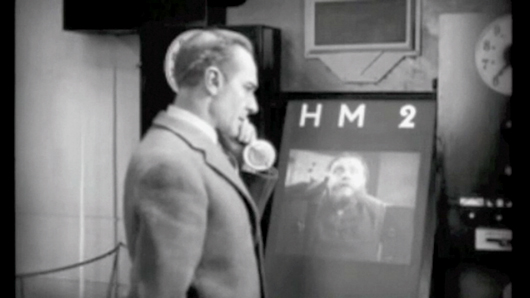
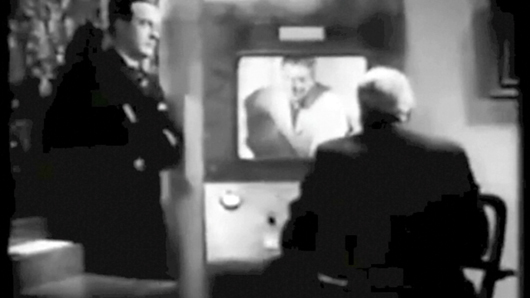
Transatlantic Tunnel (1935)

Features two very different pieces of industrial design at either end of the call.

This device displays similarities to the form of a TV set…

And this one has been designed to appear more like furniture. The screen is low down in a self-contained wooden unit designed a seated caller.

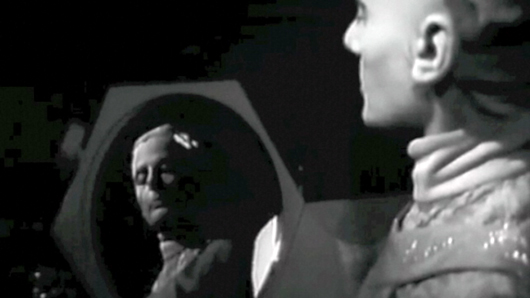
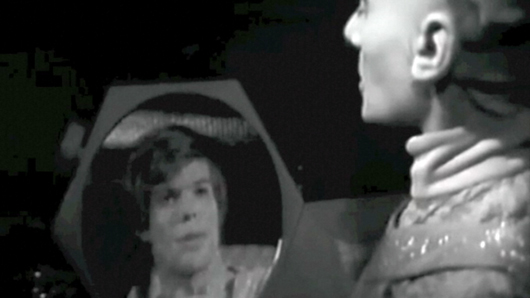
Out of the Unknown (1965)

User’s own image is reflected back to them until a connection is made. Possibly to confirm that the camera is working correctly. The hexagonal screen is an extension of a mobile chair.

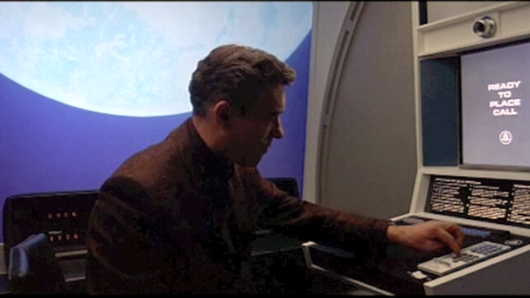
2001: A Space Odyssey (1968)

A public booth containing a large phone unit. The system communicates that it is in a ‘ready’ state through the screen. A call is made by entering a number into the type-pad and a connection established on pickup

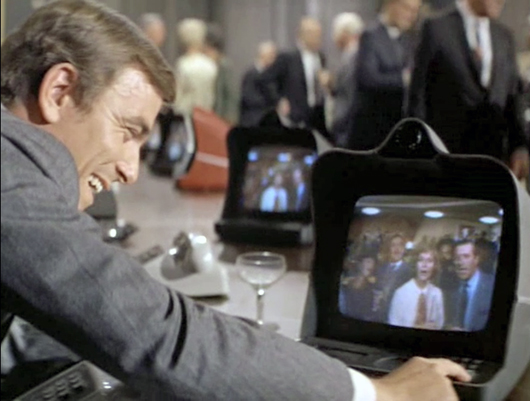
Colossus: The Forbin Project (1970)

We see five or six openly shared phones and connected screens sitting on a desk in the White House.

It is apparent that a single video feed can be broadcast to multiple screens in parallel, as below, or exclusively to a single one.

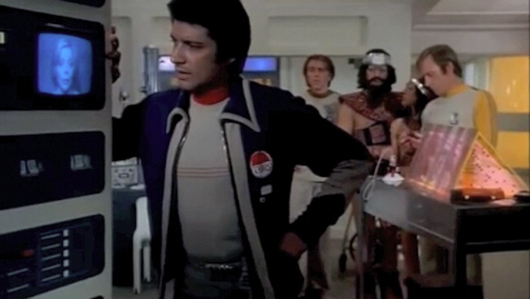
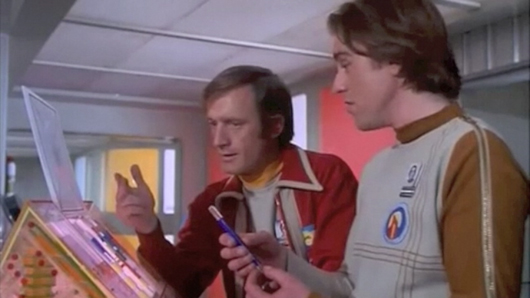
Space: 1999 (1975-1977)

The monotone blue phone screen has been designed into the very architecture of the craft.

And here requiring a key to connect.

Blade Runner (1982)

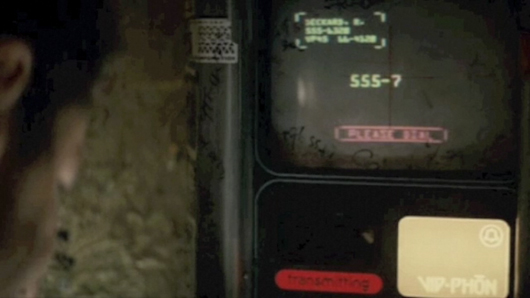
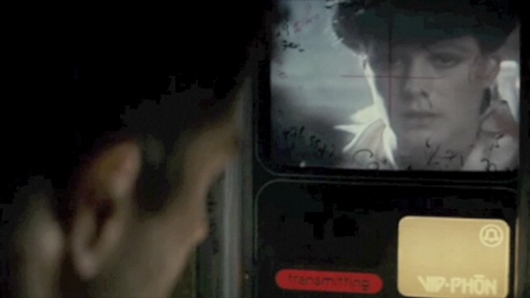
An outdoor, public phone service. Network information is displayed on screen implying that it is subject to change. When Deckard begins to dial a ‘transmitting’ notification appears. The cost of the call is shown when the receiver line is closed.

The screen is used as a canvas, covered in scrawled messages. A cross indicates the optimal position for viewer’s head.

Back to the Future Part II (1989)

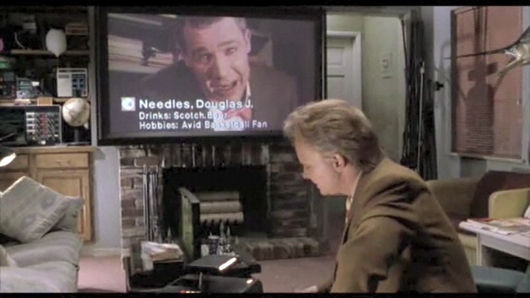
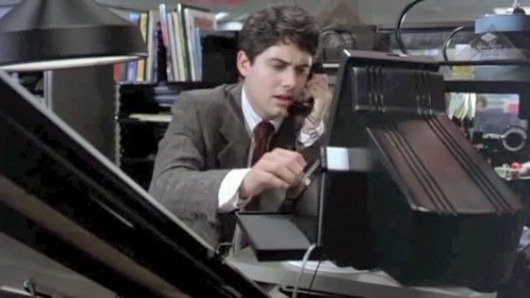
Marty McFly is contacted by Needles his coworker. The video feed features personal information about the person in view, favourite drinks and hobbies.

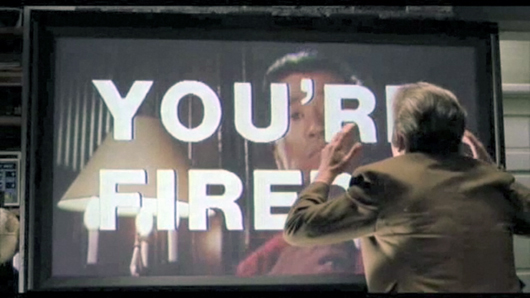
Real-time message input can be expressed as video overlays.

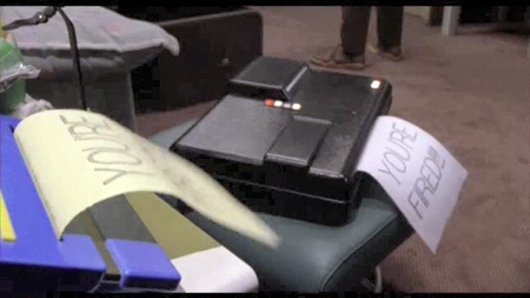
Or push print-outs.

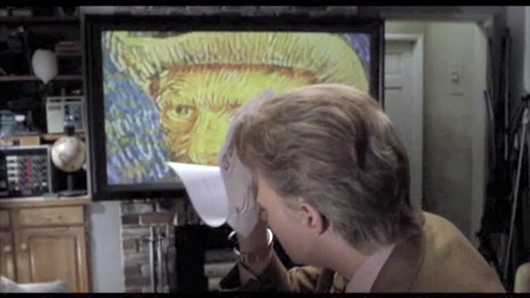
When not in use the screen displays a Van Gogh self portrait.

The Jetsons (1962-1988)

Videophones throughout the series. Rather than command desk space they lower from the ceiling when required. They appear to come with either a handset or microphone.

Star Trek II: The Wrath of Khan (1982)

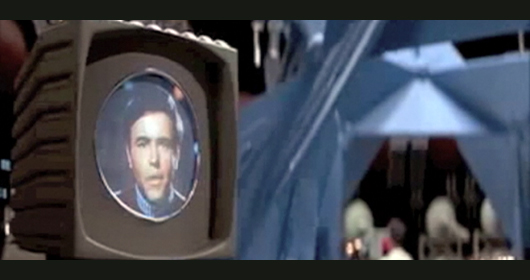
Circular screen set into a square frame emerging from a pillar unit.

Gremlins 2: The New Batch (1990)

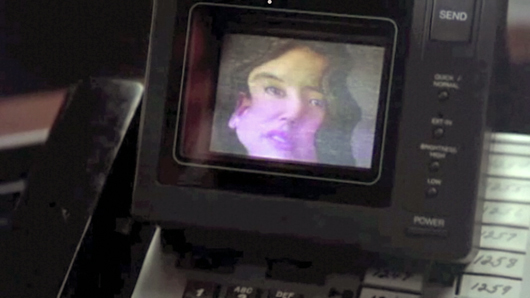
Shows a AT&T VideoPhone 2500 prototype with space for hand written addresses. When the video feed is lost the system defaults to a voice exchange through the handset.

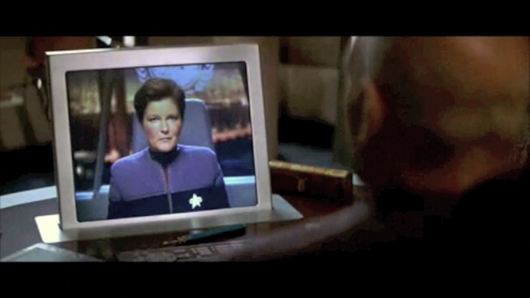
Star Trek Nemesis (2002)

Pop-up screen set into the desk. Appears when call is received. Only visible when required.

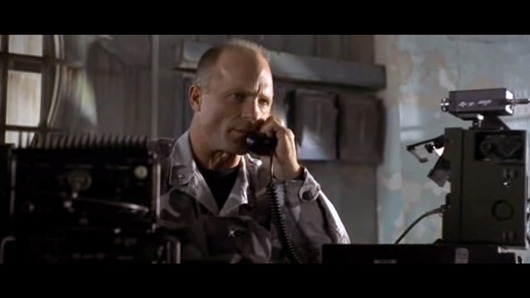
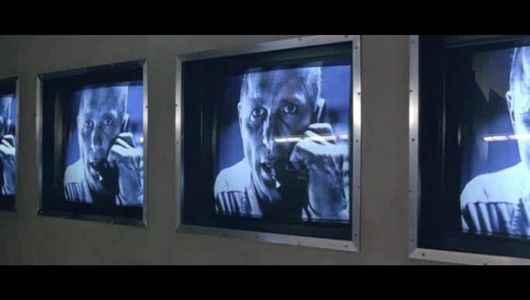
The Rock (1996)

One way video stream displayed on multiple, wall inset screens.

The Simpsons: Lisa’s Wedding (1995)

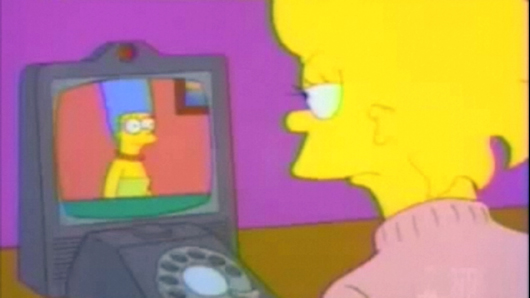
A “Picturephone” uses a rotary dial to make calls. A camera housed in the device is distinctly visible in a trapezium above the screen. Set in the future, the device seems to be a new invention that Marge isn’t quite used to yet, as she visibly crosses her fingers guaranteeing that Homer will behave at the forthcoming wedding.

Moon (2009)

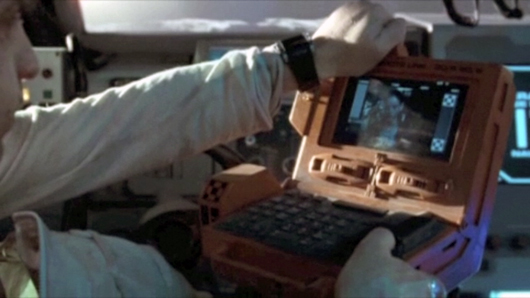
Ruggedised video phone for use in zero gravity. No function available for hiding outgoing video stream is evident as Sam Bell uses his hand to cover the camera.

And finally… the super cut of all of them

Watch the videophones supercut on Vimeo.

Recent Posts

Popular Tags