This website is now archived. To find out what BERG did next, go to www.bergcloud.com.

Blog posts from November 2009

Week 231

We are joined this week by Matthew Irvine Brown! Check out his portfolio. He’s primarily working on design for Ashdown, and possibly on Kendrick. That makes five of us in the room now, and our first meeting with the Ashdown team all together was fantastic: great energy. I’m beginning to see the path from design aspirations to product.

Tom Armitage is occupied with Ashdown this week, deep into scraping data. He’s editing a short article the blog this week too, by Georgina Voss, updating us about her ethnography on Silicon Roundabout. Matt Jones is on Ashdown, helping with the Bonnier project, following up a little biz dev, and is today at the RCA as part of his ongoing involvement in the Design Interactions brief on the future of manners.

Schulze is working with a little team on interaction design and video evidencing for Bonnier. Then he’s off to New York for a meeting or two and to speak at the Idea Conference. Schulze is away in Stockholm and maybe Oslo next week too, and it’s always tricky to have one of us away: it’s quite a delicate design sense we’re developing between us all here, and it’s one that’s fostered by working together, co-located, constantly pitching in, debating, sketching and sharing. That’s what makes it a studio I suppose. And it’s something I’d like to protect, especially in these early days, but there’s a balance to be struck. Travelling also means fresh eyes and new perspectives.

I’m liaising with builders to get quotes for the conversion of the new studio space, with accountants to answer queries on the year end and move to better book-keeping software, and researchers for: Ashdown; Silicon Roundabout; cybernetics. There are two contracts to chase and two proposals to complete. I know I say this every three months or so, but I’m busier and more productive than I’ve ever been. Last week we hosted drinks for our friends, in honour of Laika, and I got to say a few words about beginnings in general (and science fiction, of course). It’s exciting.

Oh, and there’s some new basic stuff on this site: new projects and a new talk.

I want to say something about these weekly updates, which I have now tagged ‘weeknotes’ at the inspiration of Bryan Boyer who also writes weekly updates. Kicker Studio summarise their weekly activity; Six to Start are occasional diarists; and our friends at Stamen this week posted about their first week at their new HQ. I love these.

An active blog is like a green activity light in instant messaging. For those of us who aren’t habitual bloggers, week notes help the process become regular. But more than that, companies are so often opaque. I write here whatever’s going on and whatever’s on my mind, and make connections I didn’t expect with readers I didn’t know I had. Little doors open to empathy. Running a small company is both hard and the best thing in the world. These week notes act as a kind of diary of reflections for me – I find writing them personally helpful – but they also trigger conversations with friends in similar situations about what they’ve seen before and what they’ve learned. I’d love for more companies and studios like us to keep week notes. I learn a lot, both writing and reading them, and it satisfies my nosiness as to what’s actually going on.
Links for a Monday Morning

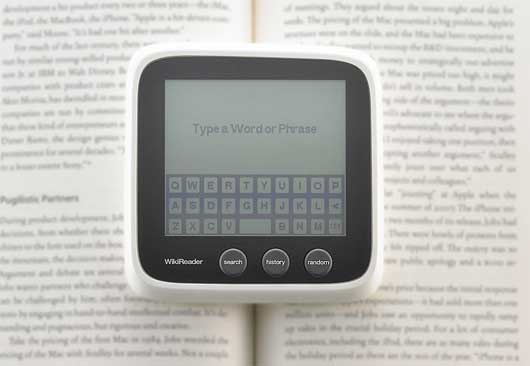
  • wikireader.jpg
    How come I’d never heard of WikiReader before? It’s a $99 device for reading Wikipedia from a memory card. There’s no network connection of any form, just a micro-SD slot, meaning it’ll last for a year on three AA batteries. You can update it at any point by downloading a new dump; if that’s not possible, you can get a new dump sent to you on a memory card for a small fee. It’s got a touch-screen, so the UI doesn’t have to be localised – foreign keyboards can be implemented in software. And, best of all, it has a hardware button marked “Random” – capturing one of the hidden joys of Wikipedia.

    It feels like a nice companion to an e-reader: book in one hand, universal lookup device in the other, and not a network connection in site. The chunky form-factor also makes it really robust and immediate; something I’d consider slinging in a bag, especially for trips abroad. It’s designed by Openmoko, and available now.

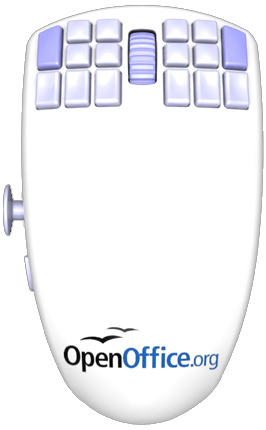
  • oomouse81.pngAnother open-source product making its debut in hardware is the OpenOffice.org Mouse (pictured left). Eighteen buttons, an analogue joystick… I admit to sucking my teeth in disbelief when I first saw it; the comparisons that have been made to the Homer seem justified.
    But take a step back, and consider it more slowly, and perhaps it’s not the car-crash it seems; instead, its problems are more subtle. Chris Messina has a sharp takes on this:

    What I worry about, however, is that pockets of the open source community continue to largely be defined and driven by complexity, exclusivity, technocracy, and machismo… so far I’ve see little indication that open source developers take seriously the need for simpler, easier, and more intuitive future-forward interfaces. Perhaps I’m wrong or just uninformed, but so long as products like the OpenOfficeMouse continue to characterize the norm in open source design, I’m not likely going to be able to soon recommend open source solutions to anyone but the most advanced and privileged users.

    Friend of BERG Phil Gyford picks up a similar point:

    The problem isn’t that it has appalling design — it’s poor and uninspired, but it’s not the worst thing ever.

    The fundamental problem is that the product is aiming for two very specific, probably unreconcilable, niche audiences (hard-core gamers and hard-core office workers) while associating itself with a brand (OpenOffice) that wants to be completely mainstream.

    I think Phil’s right. If this was pitched as, say, an EVE Online mouse, I’d probably go “oh, that makes sense for a game and UI that complex”. But for a brand trying to be taken seriously as a mainstream alternative to expensive office suites, this seems misguided, and only perpetuates preconceived notions of Open Source’s attitude towards design.

  • Schulze has bought a new car, and trust him to buy the only car I’ve seen with its own font. That is: not a font designed for the car, but a font made by the car.

    Toyota motion-captured an iQ from overhead using software written in openFrameworks, and used it to generate a handwriting font built out of careful cornering and handbrake turns. It feels like the opposite of DHL’s fake GPS art: Toyota are keen to show the software and prove it actually works. Best of all, they’ll even let you download – and use – the font itself.

  • I couldn’t let a round-up of links go with a mention to James Bridle’s recreation of MENACE, Donald Michie‘s learning machine to play noughts-and-crosses built only out of matchboxes and beads, which he first demonstrated at Playful two weeks ago.

    James was kind enough to bring his MENACE to a recent BERG drinks evening, and it drew the gasps it thoroughly deserves; 301 matchboxes is an imposing piece of computing.

  • And, finally, a nice little piece of what you might call design research: Giles Turnbull investigates nomenclatures for legobricks, surveying a selection of children he knows:

    This language of Lego isn’t just something our family has invented; every Lego-building family must have its own vocabulary. And the words they use (mostly invented by the children, not the adults) are likely to be different every time. But how different? And what sort of words?

    Hence, a survey. I asked fellow parents to donate their children for a few minutes, and name a selection of Lego pieces culled from the Lego parts store.

    Lovely. (Personally, I called a Brick 1×1 a “one-bobble” and a plate 1×1 a “flat one-bobble”).

Tangled histories

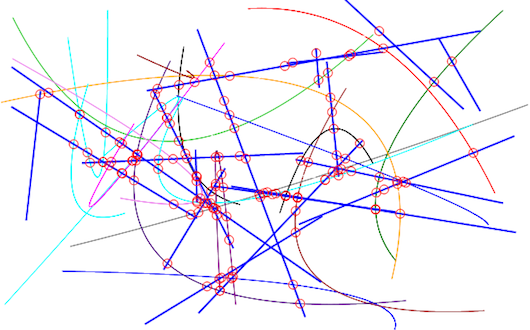
wykobi_quadratic_bezier_intersection

I saw Brian Eno and Steven Johnson in conversation on Monday night at the ICA, and Johnson talked about an approach he calls the long zoom or maybe consilience. The invention of air (the subject of his book) must take in the context of the Enlightenment; the energy and machines released by the Industrial Revolution; discussions, letters and social relations; and the shift from alcohol to coffee. All scales interconnect. None determine.

I enjoy these interwoven histories. In Pandora’s Hope, Bruno Latour tells how Pasteur and microbes bring each other to life, buttressed by laboratory experiments and arguments in letters to other scientists. Pasteur, microbes and instruments each have their own capacities to act and collaborate, and it’s only in their actions that we remember any of them; that history is made.

Yesterday morning I had an exciting meeting with a potential cybernetics researcher. I hope it works out. We found tight knots and long arcs: gnosis, McLuhan, Shannon’s information theory, mind/body, and Neuromancer; racism, eugenics, Mead, post-structuralism; prosthetics and body modification.

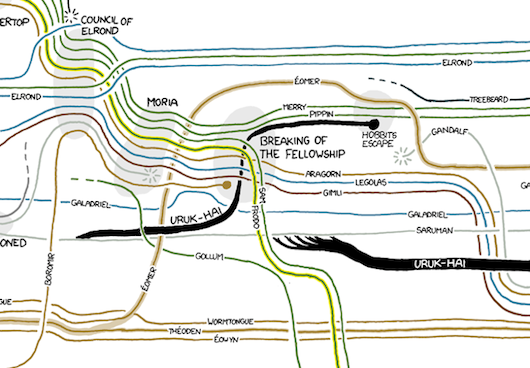
movie_narrative_charts_large

Listopad

We’re now 20 years after the Prague Revolution of November 1989, that threshold year for modern Europe. It is a tangled history: all views of the events are partial and are often contradictory. No single factor determines. Historical trajectories lasting five decades are as important as lies told to credulous protestors, and as important as an invisible-to-us political game played between the secret police of Soviet Russian and Czechoslovakia. All we can do is tell stories.

The Prague revolution is a history best seen as constructive interference; a kind of aleph moment of trajectories and events; a cloud formation in a particular spot brought about by humidity and foliage and gaps in the clouds, a nest or complex of feedback loops; a self-reinforcing discontinuity.

Some years ago I made a timeline from journals and journalism I could find online. 1989 is right at the beginning of online personal narrative, which is one of the qualities that attracted me. In the end I wrote a story about Martin Smid, the student who didn’t die, but whose death at the hands of the police catalysed the revolution: Listopad, Prague 1989.

I don’t know why I write this. I’m interested in tangles and multi-actor histories, and how you tell stories in them. Books are for the linearisable. Hypertext is for hyperhistories. I’m curious about how simple patterns in behaviours or social relationships somehow persist, complexify and grow over decades and hundreds of thousands of people, and somehow don’t die away.

That’s one of the reasons I’m interested in cybernetics — surely it’s important, the weird individual relationships, the probes into the nature of being human, the mix of countercultural and military-industrial, the attitudes and ideas, all fermenting in the bottleneck population that contributed so much to modern culture? Surely those patterns persisted and weren’t diluted, and will throw light on the here and now? Beginnings matter.

Week 230

Last week’s financial modelling resulted in a graph of the company’s invoices and cash receipts back to July 2007. I can read my feelings off it month by month: there’s an early year of maintaining one big consultancy gig per quarter coupled with a single long running project. Good. I can read a year ago, November 2008, the beginning of the time I called the Dayuejin – the Great Leap Forward – when we decided to begin to grow. The following six months are spiky: there’s a month of cash followed by a month of drought and hunting for work, and the pattern repeats. Looking at the chart I can remember the inclines and angles of the lines in my legs. It feels like hiking.

It’s satisfying to see this present epoch, the Escalante, made literal in grey and blue. In July 2009 the oscillations finish and we’re at base-camp of a steady climb. The climb won’t last forever, maybe until February next year: at that point I’m aiming for the company to be turning over nicely; cash, business development, work, R&D, exploitation, marketing, growth all running steadily, at comfortable capacity, and together, without stuttering or misfiring. It’s that operational foundation that enables products. New product development and client services live hand in hand: in expertise, ideas, attention and freedom. So I have my eye on what it will mean to achieve the Escalante – and what comes afterwards – and I’m working on building the right structures and bringing in the right projects to make that happen.

That’s the big picture. Weminuche is a big part of what happens post Escalante. And the new studio. And the people. And, and, and. But from here to there…

I guess we’re a product design company, whether it’s for Web, mobile, print, networks or consumer electronics. “Product” for us means something which you can attach marketing messages to, that has a business model in it, that has goals and success criteria, that you can rally a team behind, that is coherent to the consumer… services, content, community and experience are immaterials that we work with, intrinsically, but frankly: if you can’t say what it is in a sentence and you can’t sell it, why should we make it or why should anyone else pay us to make it? We like to make products designed to be part of social lives and part of society.

Now as part of the invention process there are weird and often gorgeous experiments and explorations. But I’m pleased to be able to say that the Here & There maps did well commercially, in addition to coming out of a long-running research project, and the collaborations with Touch succeeded in the marketplace of attention. You gotta get to market to know whether what you’re doing is any good.

I don’t know, maybe I’m being unnecessarily dogmatic, but the idea of “product” is a thread that runs through a lot of our work, and I’m trying to think through and unpack what we really mean by that.

Anyway. The projects we’re working on right now – primarily Ashdown and consulting with Bonnier – have to be considered as products (with service layers! Living in our social groups!), and executed with inventiveness and beauty and popularity.

And the two projects I mentioned at the end of week 229, they have to be about inventiveness and beauty and popularity too. A quick update on those: it was a great Friday last week. We have codenames for both now. I’ve commented on a draft of the contract for Walnut. And on Kendrick we’ve agreed budgets and the engagement fee, and we’re waiting to see the contract and PO. Massively exciting.

I should say what we’re up to this week…

Schulze and Matt are working with Bonnier at the beginning of this week. Schulze will move onto organising builders for the new studio, and planning how we invest in the development of two products of our own. He’s also working on pitching Weminuche, and helping with Ashdown.

Matt Jones will focus on Ashdown. It’s an Ashdown week in the studio: everyone has something to do. I’m going to rustle up some meetings, Tom is building scrapers for data and making more visualisations, and Matt is leading the design effort. Matt Brown, previously Lead Interaction Designer at Last.fm, is joining us to work on this (and other things) for a few months, and he’s starting next Monday: it’s super exciting and a big moment for us, and we’re prepping the ground so he can get off to a flying start.

Three Matts. This is going to be confusing.

Tom’s also writing for the website this week. We need to keep an eye on general marketing because of how busy we’re going to be on projects for the next couple months. If the website’s not growing, that’ll bite us come February.

I’m on contracts, pitches, interviewing, and bedding down the new operations infrastructure we now need. For instance: we have an intranet. The long ascent of the Escalante always comes back to the moment by moment. If it’s true, that behind the mountains there are mountains, then you shouldn’t climb only for the view, but for the climb itself. Make every step satisfying.

Recent Posts

Popular Tags