Blog posts from January 2006

Ready-at-hand and Present-at-hand

I find that, picking up one of the rubber phone props, the texture arrests me somewhat and I’m suddenly conscious of the physical object in my hand. Instead of the mobile being an almost invisible conduit for the flow of communications, something I speak and hear through, I’m now aware of it as a device in my hand.

Of course this is temporarily true whenever I get a new, unfamiliar phone, and I begin to talk through the phone only when I get to know it.

In Where the Action Is (embodied interaction and tangible computing), Paul Dourish discusses Heidegger’s distinction between “ready-to-hand” (called zuhanden) and “present-at-hand” (vorhanden). The first is when you act through something, and the equipment fades into the background. Dourish gives the computer mouse as an example: You feel as though you are operating the menus, icons and so on directly, and not as though you’re asking the mouse to do it on your behalf.

The second, present-at-hand, is when the mouse becomes an object of study in its own right. Instead of it being something that equips you for a task (it being the joining between these two), you have bumped up against some aspect of its nature that makes you focus on it as an entity. This can impede your use of it as this early leaflet, How to Make Friends by Telephone, says. On page 4, this advice is given:

“Speak TO the person at the other end of the line—not TO the telephone—then you’re more apt to be pleasant and understanding.”

How does this interaction guideline change when we constantly switch between acting through the phone (to talk) and interacting with it (to consult an address book, or write a text message)? Does regarding the phone as an object of interaction prevent us from acting through it, and reduce its well-suitedness to being a communication device?

Maybe a good place to look is the Blackberry, which mixes these two forms of interaction happily and successfully. I wonder whether part of its success is due to small touches such as the on-switch pointed out by Rod McLaren:

“The BlackBerry is usually left on all the time, and when slipped back into the holster a magnet switches off the screen. The holster is more than just an inert wrap of protective plastic: as well as protecting the screen, it saves battery life and allows the handset to appear instant-on and ready.”

When you unholster a Blackberry, you don’t need to turn on or unlock the keypad. Perhaps this makes it easier to “act through” the physical device to directly manipulate the data of emails and appointments.

A question

Now I’m thinking in this way, it’s fun to consider some counterfactuals. Imagine that mobile phones were regularly covered with awkward materials (high friction and abrasive). What forms of physical interaction would we design in, in order that the phone “disappear” and become something that we could act through?

No answer I’m afraid, but something I’ll be considering.
Form and woodturning

Following up on the rubber forms and mechanical wood material explorations, we look here at turned wood, how it reacts with the expectation of the mobile phone, and what questions it provokes.

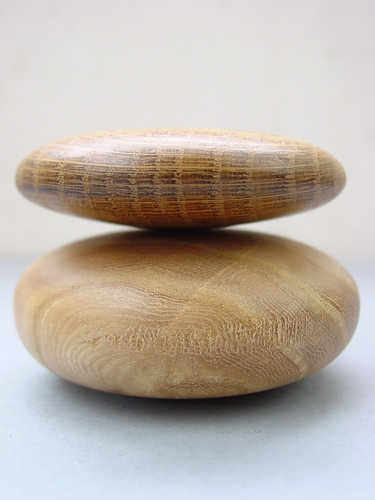
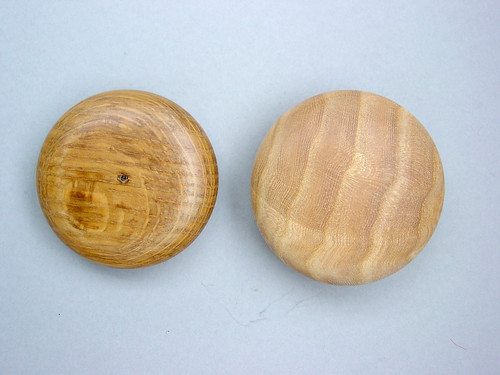
These wooden pills, made for us by Duncan Kramer, run completely counter to the painful, awkward silicone rubber shapes.

Making by Duncan Kramer

We just wanted these objects in our hands. They look a little like make-up compacts, or something else very definitely non-technological. The wooden surface is organic and permeable; it will absorb things. It smells of wood. When you hold one of these pebbles in your hand, it just begs the question: What if this lit up with phone-ness, how would it look?

In the movie The Final Cut, Robin Williams plays an editor who assembles memorial biopics of regular individuals after they die. His video editing workstation—keyboard, screen housing and all—is wooden. It seems apt.

Robin Williams in The Final Cut.

Wood is organic. Wood weathers. There’s something about turning one of the pills in your hand, and taking two and rubbing and clacking them together. The turned wood pills feel like they should be taking part in rock stacking, or one of Andy Goldsworthy’s natural, ephemeral sculptures.

Stacking.

We go through these explorations because we want to discover the natural movements of the material—what you want to do with them. What are my natural moves with my current mobile phone? I tap it on the table mainly, I guess, and that has no function. But with a wooden phone, like one of these, I want to spin it, and turn it over and over in my palm. These are intuitive actions every bit as valid as our “intuitive” want to poke at a keypad button or flip a toggle switch. I believe that when we use these new materials to make a phone, we should look at how these movements can be used in our everyday interactions.

Other material explorations

Other material explorations are linked from the Materials explored page.

Form and silicone rubber

These silicone rubber and latex objects are the least technological of our material explorations. Simply by producing the familiar shape of the mobile phone in unfamiliar materials, we can investigate our expectations of the texture and comfort of the purely physical form.

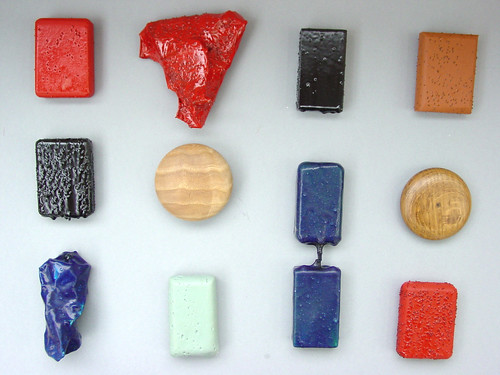
What you can see in this picture is a collection of rubber-covered wooden blocks (the connected one is latex), produced for us by Duncan Kramer (see also his biography). There are a couple of turned wood shapes, which I’ll discuss separately.

Making by Duncan Kramer

I’m only going to show the photos of the models and immediate impressions in this post, to avoid spinning off into speculation (as I did in a couple of draft posts already).

Defiant

What does it means when a phone is defiant about being put in your pocket?

High friction surface

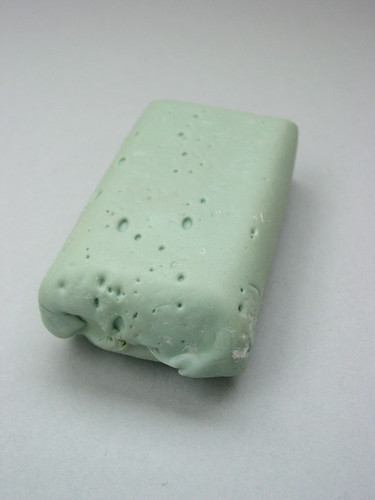
This light green surface has very high friction. With its bubbles and tiny holes it looks a little like a coral. To the touch, the only way to describe it is dry. It’s not sticky, but it defies slipping easily into your pocket. Yet the surface, when you push it, gives slightly. If you mark it with your thumbnail, it remembers a little. All surfaces have this kind of memory eventually, as they accumulate cracks and scratches, but this one acknowledges it too.

Awkward

Where do you put your phone when you’re not using it, and when you are using it?

Floor surfacing.

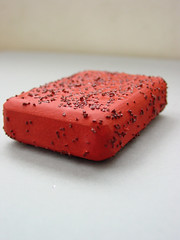
These wooden blocks are painted with factory floor surfacing. The black dotting you see on the surface is extremely hard carbon grit: The paint doesn’t chip, and you can’t pick the grit off. It’s beautiful, sharp and painful. You wouldn’t want to hold one of these against your cheek, and it’d shred the inside of your pocket if you kept it in there for any length of time.

Yet, despite the abrasive surface, the shape of the object compels me to touch it. Maybe it’s because I so strongly associate shapes that would fit in my hand with items I should pick up (I’ve written more about this in Expectations). I think I also recognise this kind of tentative touching and, paradoxically, it’s from expensive or fragile materials: I hold this scratchy block carefully… in the same way as I’d hold a delicate, inflated origami box. It’s curious that the same kind of interaction is triggered by a possibility of damage to either the handler or the handled.

Broken

When we look at a crumpled object, how do we expect it to feel or function?

Rubber rock.

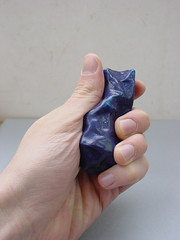
Like the other rubbers, this blue, crumpled object feels warmer to the touch than plastic. It gives a little when you push it, but not too much. It’s more comfortable to hold in some ways than in others. Looking at it, you expect it to be broken, but it will keep this shape. It’s an aesthetic I like, personally. It’s punk.

Linked

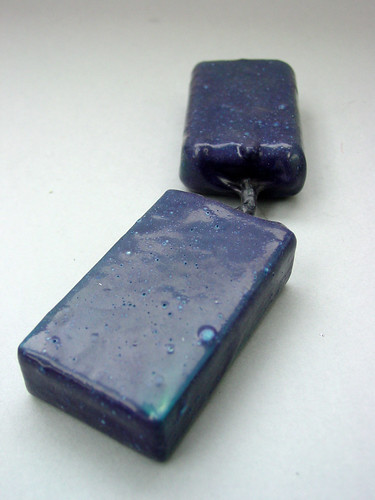
If you were making a clamshell phone, covered completely in rubber, I think you’d have to join the two portions something like this. The latex coating on these blocks turns into a connecting cord.

Connected latex-covered blocks.

I’m not sure of the origins of this piece—whether Duncan made connected blocks accidentally or deliberately—but I like the way there’s no plug or socket for the join: The same material wraps everything.

Other material explorations

Other material explorations are linked from the Materials explored page.

Expectations

Looking at the items I’ve talked about so far, especially the rubber ones, I’m trying to understand why holding a phone-shaped object in my hand seems to spark more ideas than looking at an upshaped material sample. I hasten to add that this post is extremely speculative, but I think it’s something to do with the clash between expectation based on shape and experience of mobile phones, and the reality of the material itself.

There’s something about the proportions of a mobile that says, very loudly, “this is a mobile phone.” In fact, this holds true for all kinds of distinctively proportioned shapes: Television (4:3), postcards (3:2), cinema (16:9) and more. I’ve sketched some below.

Some familiar proportions.

The sense of expectation is so strong that as soon as we encounter something shaped like a mobile phone, we start to treat it as a mobile phone. The shape stands in for the whole mental symbol of “phone.” When people see our wooden phone templates (shown in the post on fabric), for example, they often put one to their ear. It’s only natural to do so.

The flipside of this expectation is that it’s hard to see exactly what’s wrapped up in that single symbol.

It’s easier to explain what I mean if we consider a different, strong symbolic shape. When you watch television, you look at the picture through the TV and not at the device itself… but how much is the plastic box itself bringing to the experience? How can you tell?

Consider typography: Letterforms are extremely strong symbols. Think about the training typographers have to see the arrangement of the material comprising the letters (ink, neon tubes) and its properties as a material (perhaps it dominates the illustrations on the page, or connotes a feeling of modernity) rather than reading the letters themselves.

My question about the mobile phone is: To what degree does my historic experience of mobile phones influence my impressions of and my interactions with this particular physical thing? What is contingent upon the physical object?

By having objects that make you expect mobile-phoneness but then strongly conflict with that expectation, like the high-friction rubber surfaces, this question can be drawn out. In that sense, the silicone rubber material exploration is very simple: It’s about awkwardness and conflict, just to see what it revealed.

Recent Posts