Nokia: Personalisation
Investigating mobile phone personalisation with Nokia through material exploration, and a metal phone that changes form while you wait.
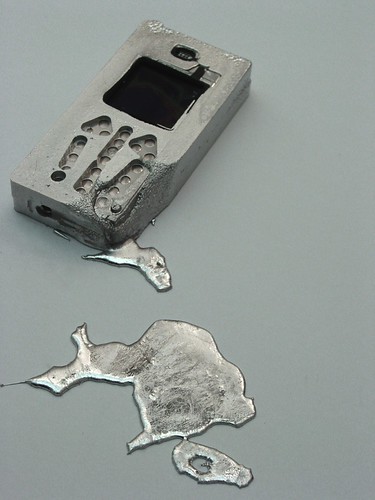
BERG worked with Nokia to develop experimental prototypes to explore personalisation in mobile phones.
There are three overlapping strands in the project: craft, hacking and mass customisation. Craft is broadly about working with people who have specialist skills in the areas of making; by hacking we are referring to combining the phone with other objects or interfering with the phone functionality; mass customisation refers to processes and materials available to small or local manufacture and appropriate to short run production.
BERG worked with specialists to produce material explorations, and posted the findings on this project blog. Have comments or feedback? Let us know.
This project blog discusses our work. S&W was commissioned by Chris Heathcote of Nokia’s Insight Foresight Group. All work remains the property of Nokia and permission is needed for any reproduction.
We’ve been working with Chris Heathcote at Nokia, Insight Foresight on mobile phone personalisation. We’re addressing questions about mobile phone manufacture, and who takes responsibility for how they’re used, and what they represent. The work is grounded heavily in prototyping and making, building on research Chris has already done. We’re documenting the project’s progress and the physical outputs here.
The material exploration brief in this case dealt with the ways mechanical forms could be of interest when using wood. Through this we made particular references to traditional toy making, cabinet making and cigar boxes (these are areas that demonstrate the specific material qualities of wood that had attracted us).
Our major challenge in this strand isn’t “how do we make a phone out of wood?” A mobile phone isn’t just a physical form, so instead we need to investigate how wood affects the networks of people using and creating the phones. Once we’ve researched this, we can design a mobile phone that illustrates those changes, and build it properly. This brings us to the real challenge: How do we even begin finding the answers?
As I suggested in Material explorations, we picked a number of different materials to explore in this way (there are some others where we’ve used a different approach). I’ll be linking to them here, and this post will bounce to the top whenever a new one is added.
This material exploration took us in the direction of fabric and, in particular, what non-specialists would do at home if the phone encouraged them to make use of handicrafts and fabric.
Hi folks. This is just a quick update to say thanks for the links, and to let you know that there are a couple of new write-ups of material explorations in the works.
Looking at the items I’ve talked about so far, especially the rubber ones, I’m trying to understand why holding a phone-shaped object in my hand seems to spark more ideas than looking at an upshaped material sample. I hasten to add that this post is extremely speculative, but I think it’s something to do with the clash between expectation based on shape and experience of mobile phones, and the reality of the material itself.
These silicone rubber and latex objects are the least technological of our material explorations. Simply by producing the familiar shape of the mobile phone in unfamiliar materials, we can investigate our expectations of the texture and comfort of the purely physical form.
Following up on the rubber forms and mechanical wood material explorations, we look here at turned wood, how it reacts with the expectation of the mobile phone, and what questions it provokes.
I find that, picking up one of the rubber phone props, the texture arrests me somewhat and I’m suddenly conscious of the physical object in my hand. Instead of the mobile being an almost invisible conduit for the flow of communications, something I speak and hear through, I’m now aware of it as a device in my hand.
So where did all this work end up? Metal Phone is a project that comprises a mobile and a machine, and talks to all the strands we’ve been investigating: personalisation, manufacture, materials and so on. Read on for a discussion of the themes and lots of pictures.