Webb’s on holiday after delivering his keynote at Web Directions South. He’ll post the slides/notes when he returns from his spirit journey but in the mean-time here’s the bibliography.
Tom is still doing his data-botany for Ashdown, running around in servers with his butterfly net made of finest regexp to see what he can find, and making beautiful magnified watercolour illustrations for the info-bestiary.
The edges are starting show in this particular patch-ecology, as are the gaps – not only in terms of what’s not there, but also the space-between where we could add data-on-data and make interesting new things to show people. Again this is an approach that worked really well while we were developing Shownar, and it’s bearing fruit already for Ashdown.
I’m still working on some initial Ashdown brief writing and project planning (which is coming on leaps-and-bounds thanks to Tom’s investigations), a bit of new business development and going to the inaugural Icon Minds event tomorrow to see Bruce Sterling talk “Design Fiction” with Dunne + Raby.
Schulze started the week with a splash, launching the Immaterials film, as part of our collaboration with Timo, Einar and the Touch project It’s since been io9‘d, Ellis‘d and Slashdotted and we’re really pleased with how both the tech and design communities are engaging with it.
He’s also working with our modelmakers on new, improved Ojito prototypes and looking at manufacturing options and sorting out the final stages of our negotiations for a new studio.
Both Jack and myself are off at the end of the week to Sweden to run a really exciting new media design project workshop for one of our favourite clients which will be intense.
Finally – as Autumn has finally arrived and we found ourselves shivering in the studio, we’ve invested in some state-of-the-art thermoregulation apparatus, that we’ve codenamed “Ojiter”.
(O-heater… Geddit?).
Dont worry.
Normal pun-free programming resumes next week when Webb returns…
This image is a photographic mapping of the readable volume of a radio field from an RFID reader. The black component in the image is an RFID reader, similar to the component inside the yellow part of the oyster card reader. The camera has been fixed in its position and the reader photographed. Using a tag connected to an LED we paint in the edges of the readable volume with a long exposure and animate them to show the form.
Following Nearness, the chain reaction film, is Immaterials: The ghost in the field, our next film with Timo Arnall at the Touch project. There are 4 billion RFID tags in the world. They may soon outnumber the people. Readers and tags are increasingly embedded in the things and environments in which we live. How do readers see tags? When we imagine RFID and their invisible radio fields, what should we see? Immaterials explains the experiments we have performed to see RFID as it sees itself.
There is a power to be found in understanding everything from systems, to APIs, to components, to data, through to their enveloping materials (such as plastics and metals) as substrates to interfere with, bend and test. Through this we form complete wholes that make a common cultural sense to people, as products. The common category that contains services, APIs, plastics, componentry and their manufacturing processes is their behaviours and their consistencies, their immateriality.
We need to richly understand the behaviour and nature of the tag interaction with readers. Timo summarises:
It is incredible how often RFID is seen as a long-range ‘detector’ or how little relevant information is contained in technical data-sheets. When this information is the primary material that we are working with as designers, this is highly problematic. By doing these kind of experiments we can re-frame the technology according to our experience of it, and generate our own material knowledge.
There is a sequence in the video where I briefly discuss the directionality of tags. Most tags (and therefore their antenna) are flat. They have a direction. The shape of the readable volume changes according to the antennas orientation to the reader. The following image shows two volumes. The first visualised with green LEDs shows the readable volume from interactions between a reader and a tag parallel to it; the second, visualised with red LEDs, shows the volume produced by the same tag held perpendicular. Two very distinctive and different shapes can clearly be seen.
It is not the radio field produced by the reader itself we are looking at. That is much, much larger. The images show the volume in which the energy in the space surrounding the reader is inducing a current large enough to wake and run the RFID chip at the end of the antenna in the tag. The readable volume can be mapped around a tag or inside the field produced by a reader component, but it only exists between the two.
Having produced these visualisations, I now find myself mapping imaginary shapes to the radio enabled objects around me. I see the yellow Oyster readers with plumes of LED fluoro-green fungal blossoms hanging over them – and my Oyster card jumping between them, like a digital bee cross-pollenating with data as I travel the city.
We work with traditional materials and fabrication for our product and industrial design, but the exciting contemporary products of our age are more than the sum of their materials, those poorly bound knots of plastic and silicon in our hands and homes.
Matt Jones described what we do as ‘Post Industrial Design.’ Perfect! Where once industrial design was concerned with radii, form, and finish, we now deal in behaviours, experience, shifting context, and time.
The products we design now are made with new stuffs. Service layers, video, animation, subscription models, customisation, interface, software, behaviours, places, radio, data, APIs and connectivity are amongst the immaterials for modern products.
Immaterials are the new substrates for opportunity and risk in product design.
Augmented Reality Link Of The Week #1: Scope, by Frank Larsome. Scope is an AR tabletop wargame, played with special markers and (in a nice touch) any toys you have lying around. The interface and “game” elements are all projected onto the scene through the goggles.
I like this because it’s consistent and realistic in its use of AR: it makes sense to wear goggles or some other kind of apparatus, because you’re an army commander surveying a battlefield. And I like that reality is genuinely being augmented here: the AR element is interface and head-up display, as opposed to some 3D element pretending to be real but clearly failing at that. AR is, quite rightly, part of the novelty of Scope.
And from the sublime to the ridiculous, as it were. This is Tribal DDB Asia’s “3D McNuggets Dip“, “The first 3D Augmented reality dipping game with McNuggets”.
It’s AR as pure novelty: a marker to be used with a Flash webcam app, dragging an AR McNugget around a screen much like you might with a mouse, the sole novelty in the proposition being AR. It’s barely AR; it’s more Marker As Interface – much closer in implementation to the way a Wii Remote might be used.
Excitingly, they’ve been targeted not at existing eReaders, nor a simplified eReader aimed at children, but to a device with a touchscreen that many kids already own: the Nintendo DS.
It’s a deal between publishers Egmont Press and Penguin, with games company EA. The titles are priced at £24.99 – nearly the cost of a full DS game, but each cartridge has “6-8″ titles on it, which cuts the cost per book down to that of a paperback. And then, of course, there’s all the supplemental material.
I like the idea of Flips (as the titles are known) because they’re basically nothing new: an existing product retargeted simply by aiming at a new, simpler, cheaper platform – and one that many kids already have. There’s nothing complex here in the software or the strategy, but if the implementation’s good, then perhaps they’ll be a success.
Sure, the DS screen isn’t as easy on the eyes as a Kindle’s, and the resolution is lower, but that might be less of an issue for ten- and eleven- year olds.
It’ll be interesting to see how they sell; it’ll also be interesting to see if it sparks interest in reading, and also where they’ll be stocked: games shops are likely to carry them, but will bookshops as well? We’ll find out in December, just in time for the Christmas rush.
And, finally, a small piece of gaming nostalgia that made me smile: the 1978 Atari catalogue, featuring titles for the VCS/2600. I like it if only for its emphasis on anything but the game screens, instead focusing on the large amounts of commissioned art. That cover brings nothing to mind so much as Mr Benn, and reminds me of the escpaism – the different outfits one can wear – that computer games have always had at their heart.
I had the privilege of opening Web Directions South here in Sydney, this morning, with a hike through fanufacture, science fiction, social capital, cybernetics, and Neptune. The reception has been great and I totally enjoyed myself! What more can a man ask for.
A few folks requested a bibliography, so here we go. You can pretty much reconstruct my entire talk from this. Books and articles, in order of appearance!
Matt Webb’s down-under preparing for his talk at Web Directions South, prior to him going on holiday for a bit, so I’m writing the weekly update! I’m drunk with the power!
So – in summary: Schulze is spending the week in zero-g combat training, Tom is playing with an orangutan genome that he got from some guy in Zurich and I’m building a laser-harp.
Not really.
Jack’s working on Ojito some more this week, and with me on new business development. He’s also working on some animations with Timo for the Touch project.
He’s wrangling it now to the point of finding the interesting edges and qualities to output that into graphical, understandable diagnostic artefacts that will help us when the design begins in earnest. I find this really useful in particular, as more of visual thinker – helps me get my head round the territory far faster. Boundary objects.
He’s also doing a little bit of sound design on the side for our casual game proto that we’re delivering at the end of the week. Busy boy!
I’m still working with Paul Pod on that sprint. It’s been a really short intense project but I’m super-pleased with how it’s going and from what we can tell so is the client – hopefully it will lead to something bigger…
Luckily, having worked with Paul before he’s able to understand garbling like that from me, and go far beyond what I imagine.
I’m also preparing the project plan and internal briefing documents for Ashdown. Writing a brief for a project that you’re going to design might seem a little odd, but of course it’s still valuable in order to really set some goals and scope going in.
What else? Well, I’ve already mentioned the new business development meetings with Jack, and I’m writing a final proposal for a mobile storytelling tool we hope to prototype.
Players stand in front of a green screen while the game films them and creates a music video background while they sing. Their performance is then emailed to them or burnt onto a DVD players can take home.
How’s that for a piece of product design? I particularly like that it offers you a choice of DVD or emailed video file – the latter leads to an instant community of Star Studio videos on Youtube, the former to replayable experiences for families. Of course, the make-or-break is going to be the quality of the videos, and whilst they’re obviously somewhat cheesy, the output – from a cheap green-screen in a photobooth-sized cabinet isn’t half bad, when you watch the videos of the developers playing:
Would it have sold DVDs to kids in malls and arcades across the US? We’ll never know.
I always enjoy Chris Dahlen’s writing, and his lateset column for Edge Online – about “user-generated, machine-mediated content – UGMMC, or ‘Ugh-Meck’” is a cracker. User-generated content is a hot topic in the games industry right now, but it’s not without its drawbacks – notably, the time and skill required to make anything in even the most basic of game editors.
Dahlen proposes something different: using content that players are already making – on serivces like Twitter or last.fm – and working that into their games:
“…what if you make personalisation easier? Consider a game that brings your real world into your game world, all on its own. It could grab data from the internet about the real world and the gamers that live in it, and weave it into the game experience, for an effect that is both surprising and personally meaningful. You would see yourself in a game without having to put yourself there.”
Dahlen’s clearly only scratching the surface – it is, after all, a column rather than a design document – but he’s expounding on something good. And he ends on a note about narcissism that I find convincing in its poetry:
“…even used sparingly, Ugh-Meck personalises an experience for even the laziest user. It shows us our reflection – however tiny, however distorted – inside our games, an experience that is guaranteed to mesmerise us.”
Another writer I’m a big fan of is Joe Moran, an academic at Liverpool John Moores Univeristy specialising in cultural history, and author of the marvellous Reading the Everyday, which I’ve written about on my own blog before (and spoken to many people about at length).
And finally, here’s a video of a pancake-sorting robot, that can stack 400 pancakes a minute. Why? Because I like videos of robots in factories, especially when they’ve got arms as interesting as that one. Worth watching to the end to see it really hit its stride.
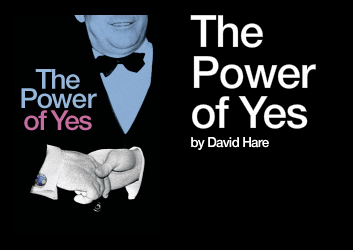
In the playwright’s own words, spoken by Anthony Calf as he takes the stage at the beginning, playing David Hare:
“This isn’t a play. It’s a story. It doesn’t pretend to be a play. It pretends only to be a story. And what a story! How capitalism came to grinding halt. Where were you on September 15th 2008. Do you remember? Did you even notice? Capitalism ceased to function for about four days. This summer I set out to find out what happened.”
The huge bare stage is then flooded with characters, although the actors are playing real people – some anonymous however – and for the next two hours, you are gripped by, as one of the characters describes it “…a Greek tragedy”.
It’s funny, informative and through the eyes of Hare – the ‘fool’ who can ask stupid questions of the financiers – you get a complete picture of the financial crisis of 2007-2009 both in terms of the abstract-big-picture of what went wrong with the system, and the human-scale – what went ‘wrong’ with the people.
This was the first time not only that I felt I’d really understood ‘credit default swaps’ (despite enjoying songs about them) and the other arcane instruments at the heart of the situation, but also the motivations behind the actors (if you’ll pardon the pun) involved in the real-life drama.
Thinking of all of the newspaper and tv news coverage that there’s been, it’s remarkable to me at least that a dramatist not a journalist, economist or political scientist did this.
But then I think of another favourite macroscope, another Greek tragedy, about a favourite subject of mine: cities – which was created by a dramatist who was a journalist, David Simon – and recall Oliver Sachs saying


 And, finally, a small piece of gaming nostalgia that made me smile: