For a sense of place to my moment, I will tell you I am on a wireless keyboard, swinging on a homemade swing on the first floor in the three story high living room of the person that would be my it’s complicated on Facebook if I had a Facebook.
My computer itself is on the second floor. As I type these words into the air I have no way of knowing for sure that they are not ephemeral, nothing to confirm my progress and therefore distract me from my thoughts. I strongly suspect that for all the weirdness of the moment, they are (in fact) among the least ephemeral words penned by mankind
My emphasis. Awesome.
Then, birth control pills: The modified were women, and the environment was men.
Then, quoting theory: Cyborgs not only disrupt orderly power structures and fixed interests but also signify a challenge to settled politics, which assumes that binary oppositions or identities are natural distinctions.
Then, I don’t think we’ll ever notice the age of cyborgs, because we do these things one at a time.
Quinn ends by looking for new language, for ways to talk about the world of cyborgs we already live in, and the kind of un-cyborgs coming into being that we didn’t expect.
For this Friday, a selection of links from around the studio about screens-in-the-world.
This video is the output of the TAT Open Innovation project – an exploration of the future of screen technology. Of course, more than ever, “screen” is becoming interchangeable with “device”, as this video explores the actions and interactions made possible by new kinds of device, both mobile and static.
And here’s Freescale Semiconductor’s vision of a screen-driven future. Smart mirrors and see-through tablets are increasingly popular tropes of the future right now.
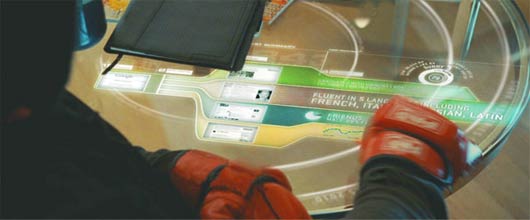
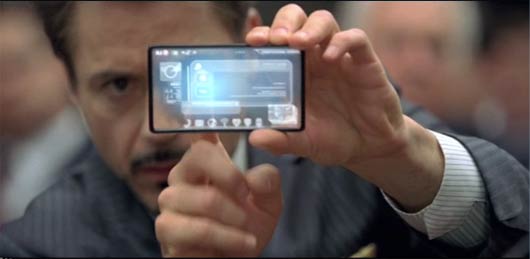
Two more examples of transparent screens – one portable, one embedded in the environment – from Perception’s work on the visual effects for Iron Man 2. Such tropes aren’t just limited to concept videos; they’re also a part of popular culture.
Chris O’Shea’s Hand From Above makes a playful use of giant, public screens. These screens are so often passive, broadcasting devices. It’s strange and jarring – in an exciting way – to see them interacting with us. It’s like they can see.
Keiichi Matsuda’s Domestic Robocop envisages an augmented-reality future where the augmentation outweighs the reality. Practically every surface in Matsuda’s imagined kitchen has the capacity to become a screen – most of which end up displaying advertising, generating income for the homeowner.
There’s an overlap I’m beginning to see here: between “screens everywhere“, and “everything being a screen” and what we’re currently calling augmented reality. Thinking on that, I can’t help but return to this lovely video from our friend and collaborator Timo Arnall. It doesn’t matter how the map appears on the street. For the woman on the bench, the ground in front of her is the most sensible place for the map to appear. Large pieces of information can make good use of large spaces. Why not, then, make the “screen” as big as possible, and use the environment itself?
There were an awful lot of photos taken for the Making Future Magic video that BERG and Dentsu London launched last week; Timo reckons he shot somewhere in the region of 5500 shots. Stop-frame animation is a very costly process in the first instance, but as the source we were shooting was hand held (albeit with locked-off cameras) and had only the most rudimentary of motion-control (chalk lines, black string and audio progress cues), if a frame was poorly exposed, obscure or fumbled, it left the sequence largely unusable. This meant that a lot was left on the cutting room floor.
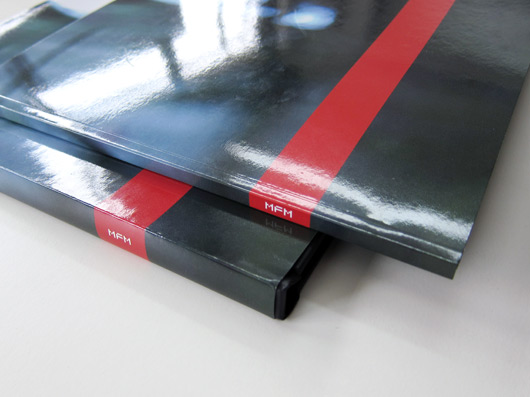
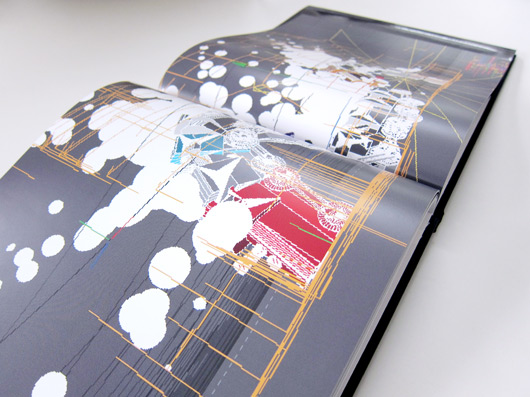
In addition, we amassed a stack of incidental pictures of props, setups, mistakes, 3D tests and amphibious observers during the film’s creation.
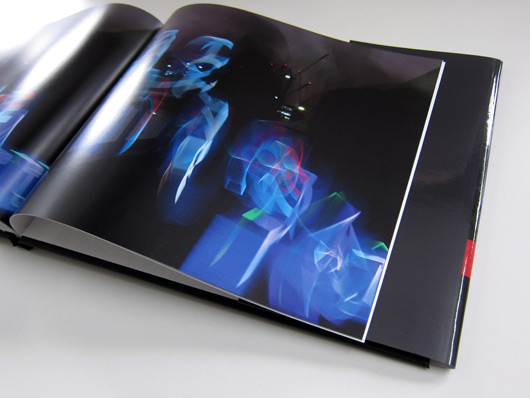
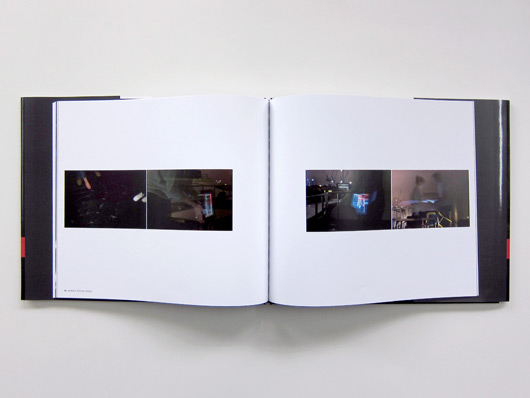
Clicking through these pictures, it was clear that a book collecting some of these pictures, offering little behind-the-scenes glimpses alongside the finished graded stills used in the final edit, was the way forward. As well as offering a platform for some of the shots that didn’t make the final cut, the static prints want to be pored over, allowing for the finer details and shades (the animations themselves had textures and colours burnt into them in prior to shooting, so as to add a disruptive quality) to come through.
Our copies arrived today from Blurb. The print quality and stock is fantastic – especially considering it’s an on-demand service – and for us it’s great to have a little summary of a project that doesn’t require any software or legacy codecs to view it and will remain ‘as is’. We’ve made the book available to the public and in two formats; you can get your hands on the hardcover edition here, and the softcover here.
Each week, Kari spends 5 minutes with each person in the studio recording what they’ve been up to. We do this so nobody has to keep time-sheets. Here’s my week.
Last Tuesday (the 14th), we launched the short film Making Future Magic. It hit 400,000 views in 2 days (it’s currently over double that). The video was picked up by Gizmodo,Stephen Fry, and William Gibson. I wasn’t on the film team, but helped with the launch preparation and saw it come together. The day Cam, Timo and Jack hit on the techniques that went on to become stop-motion light painting, it was electric just to have them in the room.
Also last Tuesday afternoon, we had the kick-off meeting for Project Blacklight. It has been slow to start, this one, as it’s a pretty unusual enterprise for us. One quirk is that the financials aren’t completely fixed yet, and they have to be before I continue conversations with potential backers and advertisers. The print tests and quotes over the next couple weeks will firm those up. Blacklight should make for an exciting start to 2011.
On Wednesday I had a meeting with a potential new client with Matt Jones. This particular client is interested in our product invention workshop, which we run either standalone or as a prelude to pretty much all our design work. It’s 3 days of intense knowledge download, concepting and co-creation, and sketching. The client ends up with around 5 “microbriefs,” which is what we call the sketches and descriptions of the products or services we come up with around their business and brief. They then take those briefs off to their existing agencies and internal teams, or ask us to make a proposal for one or more of them. (BBC Dimensions started this way, one of a half dozen products to come out of an invention workshop aimed at history storytelling and digital.)
I had a catch-up with Nick over lunch, covering everything from my current thoughts about the studio’s direction, to his progress meeting iOS developers, and what weird ideas are tickling him at the moment (I’ll make sure our proposals steer in that direction). It was really good. So I’m going to spend 45 minutes with each of the studio, individually, every two weeks on Wednesdays. It’s funny how, even in a small room, you can miss chances to really spend time together.
Jack and Matt J had a long-anticipated getting-to-know-you meeting with another possible client in the afternoon, and we spent an hour after that chewing over possibilities.
But mainly on Wednesday I was working on my talk for the Do Lectures, which was in Wales. I spoke on Thursday evening, and went from sci-fi, to the early years of electrification, to the idea that is really making me bubble at the moment: Fractional A.I. This riffs of Dave Winer’s application of fractional horsepower to the Web, where he says that new products can be made by taking an old one and scaling it down.
What if we had fractional artificial intelligence? This is another way of saying Matt J’s maxim to Be As Smart As a Puppy, and also a topic I covered in my Mobile Monday Amsterdam talk What comes after mobile. It’s a topic I’m fleshing out.
Thursday and Friday was talks, walks in the Welsh countryside (there’s a beautiful river there and you can take a short hike up the gorge. Lots of ancient woodland and slate landscapes), late-night conversations, and inspiration. You should watch the 2010 videos when they’re up.
Whilst I was away, a project proposal was accepted, and we’ll start that project off this week.
Euan Semple gave me a lift back to London on Sunday night, and I waited at Slough railway station for a train. While there, I found a stuffed dog in a box. The dog is called “Station Jim,” and he used to raise money for charity. He was quite a character by all accounts, and died in the closing years of the 1800s. I mentioned Station Jim on Twitter… and @stationjim replied! Fractional A.I. indeed. We had a little chat.
Monday, yesterday, we had a kick-off meeting for the next stage of Project Barringer. Andy is working with us a day a week to produce a pretty significant strand of the project. It’s nicely complex – lots of different skills and people involved – and a good blend of design and hard tech. But risky. So the next two stages are: prototype; detailed costings for production. We’ll have to do some pretty serious analysis at every stage of this one.
In the afternoon I caught up on a few projects. I wanted to get an update on the next film (it’s going well — the team have just been meeting to discuss the last few bits of copy), and Tom and Matt B have been working on league tables for Schooloscope and those are tantalisingly close now. I went out with Jack in the evening to run through contracts. After 40 minutes discussing “worst case scenarios” I got home a bit grouchy. It’s funny the ways in which work affects your personal life. Not just emails arriving late at night, feeling tired from working hard, or elated after a launch, but subtle emotional spillover. I try to keep an eye on that. I’m undecided yet whether a high level of self-knowledge is an advantage or hindrance for the kind of invention and design we do. But it’s important for general wellbeing.
Which brings us to today.
This morning we’ve had our All Hands, during which we had our first project updates from active new product development. These projects are like invisible people, so they deserve to have their say about their week’s activity.
I’ve set up, with Kari, an old laptop to run Dropbox. We’ve pretty much entirely shifted to Dropbox for file-sharing from our in-studio server, but that means our archives aren’t up to date. So: archiving.
A few copies of the Making Future Magic book arrived in the post (print on demand; designed by Cam. Very pretty). And I pointed Matt B at Tunecore because we’d like to put the film music on iTunes.
Jack and Matt J are at a workshop on Wednesday and Thursday, so I’ll help them prep that later. I think I’m sneaking in a massage after lunch (lunch is with some iOS developers, so we can keep them in mind for future projects). And this afternoon and over the rest of the week, I am way behind on keeping project proposals moving through the pipeline, so I want to concentrate on that. There are a bunch. Oh, and emails: way behind on those too. I have a little list of people to whom I really owe a Hello.
Last: Jack, Matt J and I were going to go out for dinner with an Interesting Person tonight, but that’s been moved to tomorrow. I can still make it — I’m not sure about the other two.
Otherwise, generally thinking about what’s happening next, and seeing where I can nudge or smooth the way as appropriate. To be honest, that’s most of my time.
Some of you might have seen this film we released with our friends from Dentsu London the other day. At the time of writing, it’s had over half a million views. Whoa.
Also, a few people have been asking about the music we used, so I thought I’d chat a little bit about it. We wrote it ourselves, here in the studio. I pasted it all together, with direction and input from Schulze, Timo, Beeker and the rest of the Dentsu crew.
Some of the best bits about working at BERG are how everyone, despite having particular specialist skills, gleefully ignores boundaries, disciplines, labels and predefined processes, and allows themselves space to just run with things when they get excited. Deciding to do the music for the first Making Future Magic film ourselves was one of those moments.
“Yeah, so who are your influences then?”
About ten days ago, after the animation had reached a final(ish) edit, I happened to overhear Schulze, Timo and Cam batting a few ideas around about potential soundtrack music. I hadn’t really been involved in the project so far, but at this point I dropped what I was doing, went a bit Barry from High Fidelity, and started throwing some MP3s at them.
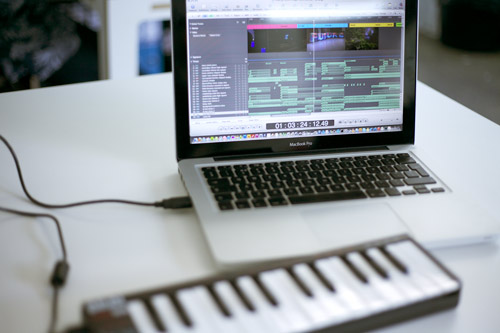
That weekend, on a long train journey, and with a few hours to kill, I was listening back to the tunes we’d picked out, and thought I’d sketch out some musical ideas to accompany a few clips of the current edit, just as a little exercise. Like loads of people I know, I do enjoy a bit of noodling around with things like Ableton Live, Logic, Beatmaker on the iPhone and so on. So I had a crack at it.
On the Monday morning, everyone had a listen, and nudged me to do a little more, just to see where it went. Gradually, things began to firm up into a “proper job”. I’d never written music for a film (or anything else, for that matter) ever before, but hey, everyone knows the best way to learn something is simply to set a risky week-away deadline involving potential public ridicule. So here went nothing.
Designing the Music – first sketches
We all know that a lot of the unseen (yet most satisfying) work in design goes into getting rid of things. Tidying up. Wielding Occam’s Razor. Making things unnoticeable. Getting things under the hood working so well you forget they’re there. All that good stuff. There are obvious parallels to this in music, but I guess this applies even more so to making soundtracks.
Not your rousing, whistle-able belters of your Williamses or Morricones; I’m thinking more about Bernstein’s work for the Eames films, John Cameron’s haunting soundtrack to Kes, anything on the KPM label, or, say, Clint Mansell, whose Moon soundtrack got quite a rinsing here in the studio last year. There’s a quiet unselfishness to this type of music which I’m really drawn to – it’s kind of half-there, beckoning you to invent accompanying stories and pictures in your head, and sometimes it’s at its best when you don’t really notice it. I imagine this rings lots of little bells in the heads of anyone involved in design or making things – it definitely does for me.
As I say, I’d never really written any music before, so pretty much used these little scraps of what I know about design (and what I love about film music) as a way in. Finding the grain of a material and playing with it; hitting on an idea and not getting in the way of it; looking for patterns; making references to other, familiar concepts, using broad brush strokes first, then (quite literally) tuning and polishing – all the usual approaches, really. The same way we’d work with any (im)material here at BERG.
So, here are the three first sketches I did. The visual glitchiness of the animation was the main thing I wanted to complement, so I went outside, made some little field recordings on my phone, chucked them all into the computer, then pressed record and left it on. I assembled the samples into few rhythms, teased out little patterns of pitch, timbre and so on, and eventually, after a few hours, out popped a few bits and pieces. It took me about 6 hours of jamming to come up with three one-minute ideas. Told you I was new at this.
That was a bit Chris Isaak meets Twin Peaks. Bland. Nah. Next.
We all sat up at this one. Warm, bubbly ARPy synths; Reichy scales and patterns; plinky, poppy glockenspiels; pentatonic scales giving off a subtle whiff of J-Pop (which might sit nicely with the Dentsu folks), and it had the most potential to grow melodically. Tick!
Building out the musical structure
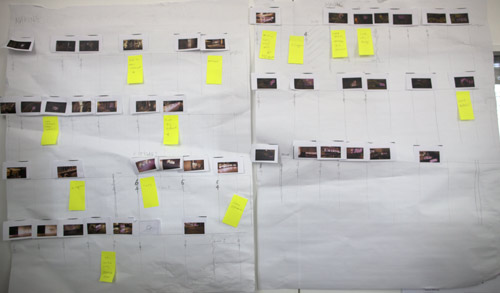
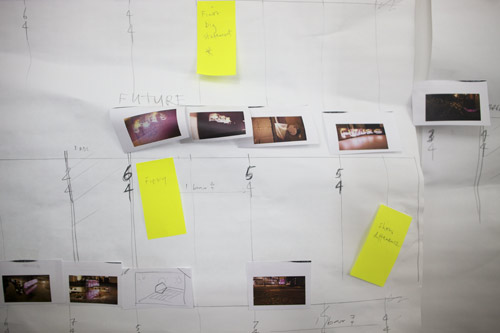
After that, it was time to work out how this sketch would evolve to fit across the whole film. The first task was to build the scaffolding we wanted to hang everything off, by translating the timing of each visual cut into bars and beats, which I did with a metronome and a few big sheets of paper. I grabbed Schulze, talked about where we wanted the main narrative pivots to be, and stuck those on post-it notes.
Since we had three sections to work with (Making, Future and Magic), everything pretty much finished itself after that. We’d built the scaffolding, so now all that was needed was the rest of the building – from the main zones down to furniture, textures, colours and so on. I blocked in the main themes and some large areas of texture, then just worked my way down to polishing little details. I don’t know much about how composers work, but this bit wasn’t all that different from we usually get from whiteboards and post-its down to pixels and working code.
Jack and Timo were still making edits to the film as I was composing, so I needed to leave a bit of slack here and there to adjust to their timings. I made little modular loops of different lengths (3, 4, and 5 notes, in different rhythms, at different speeds), which meant I could cut or extend little phrases here and there, ignoring strict time signatures as needed. Again, just simple, common sense stuff, really.
The final mix
After 3 or 4 days of tuning and polishing, we had an overall structure everyone was pretty happy with, so we got in touch with the chaps at Resonate to help us mix and master everything – the proper, detailed tuning. Big big thanks to Liam and Andy for being super helpful at such short notice! Aside from treating a novice like me very kindly, they brought a level of clarity and depth to the mix way beyond what my ears had previously heard. Here are the before and after versions. Spot the difference!
Before mixing:
Mixed and mastered:
And of course here’s the finished film.
Overall, the music took us about 6 or 7 days. A mere blip compared to the weeks of late nights that went into the animation, but a nice example of how when the studio is simmering nicely, everyone’s interests, hobbies and hunches tend to bubble to the surface and happily get put to use, all in the name of doing Good Stuff.
We’re working with Beeker Northam at Dentsu, using their strategy to explore how the media landscape is changing. From Beeker’s correspondence with us during development:
“…what might a magical version of the future of media look like?”
and
…we [Dentsu] are interested in the future, but not so much in science fiction – more in possible or invisible magic
We have chosen to interpret that brief by exploring how surfaces and screens look and work in the world. We’re finding playful uses for the increasingly ubiquitous ‘glowing rectangles’ that inhabit the world.
This film is a literal, aesthetic interpretation of those ideas. We like typography in the world, we like inventing new techniques for making media, we want to explore characters and movement, we like light painting, we like photography and cinematography as methods to explore and represent the physical world of stuff.
We made this film with the brilliant Timo Arnall (who we’ve worked with extensively on the Touch project) and videographer extraordinaire Campbell Orme. Our very own Matt Brown composed the music.
Light painting meets stop-motion
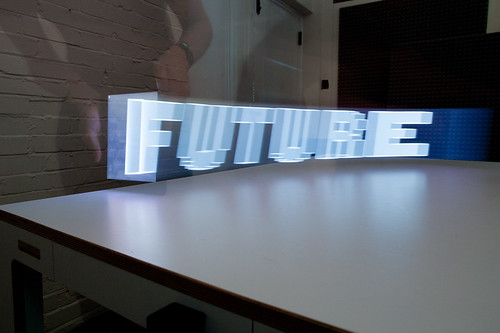
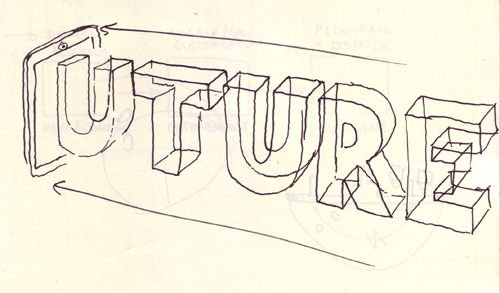
We developed a specific photographic technique for this film. Through long exposures we record an iPad moving through space to make three-dimensional forms in light.
First we create software models of three-dimensional typography, objects and animations. We render cross sections of these models, like a virtual CAT scan, making a series of outlines of slices of each form. We play these back on the surface of the iPad as movies, and drag the iPad through the air to extrude shapes captured in long exposure photographs. Each 3D form is itself a single frame of a 3D animation, so each long exposure still is only a single image in a composite stop frame animation.
Each frame is a long exposure photograph of 3-6 seconds. 5,500 photographs were taken. Only half of these were used for the animations seen in the final edit of the film.
The light appears to boil since there are small deviations in the path of the iPad between shots. In some shots the light shapes appear suspended in a kind of aerogel. This is produced by the black areas of the iPad screen which aren’t entirely dark, and affected by the balance between exposure, the speed of the movies and screen angle.
We’ve compiled the best stills from the film into a print-on-demand Making Future Magic book which you can buy for £32.95/$59.20. (Or get the softcover for £24.95/$44.20.)
Outgoing editor Justin McGuirk asked me to write a little about the near-future of digital magazines for Icon #87, in which I talk a bit about challenges of the context they now find themselves in as a media form, as well as things we think we learned during the Mag+ project.
They’ve kindly allowed us to republish it here.
Since the launch of the Apple iPad six months ago, the world of digital magazines has seen fevered activity and hyperbolic punditry.
Big names such as Wired, Vanity Fair, Time and Popular Science (which our studio, BERG, helped to bring to the iPad with the Mag+ platform) have released editions into the App Store and made proclamations that it’s the future of magazines.
However, the very term “digital magazine” smacks of “horseless carriage”, Marshall McLuhan’s term for an in-between technology that is quickly obsolete. While nothing is certain about the future of any media, there is no doubt that the digital tablet form will grow in popularity, with the iPad being joined later this year by numerous other (possibly cheaper) competitors mainly powered by Google’s Android operating system.
So, what does the future really hold for digital magazines? We can identify some challenges and some opportunities. One certainty is that the manner by which we discover and purchase magazines will be given a hefty thump by the switch to digital. We are in a world of search rather than browse – which perhaps in turn leads to a change in the role of cover design, from “buy me, look what’s inside” to “you know what’s inside, but here is an incredible, evocative image”. In many ways it’s a return to the “classic” magazine covers of the 1950s and 60s, privileging the desirability of the object itself rather than shouting about every feature.
The bounded “object-ness” of the magazine embedded in the world of the endless, restless internet is seen by most as an anachronism, but it is also one of its greatest attributes. Research we received from our client Bonnier as part of the brief for the Mag+ concept indicated that people really were attached to the magazine as a form of media that creates a bubble of time to indulge in reading – and as a contrast to other, faster forms of media.
Meeting this need – while acknowledging the breadth, speed and interconnectedness of the internet – is a design condition that has not been satisfied fully by the current crop of digital magazine offerings, our efforts included. But stay tuned.
Another change in what we might term the “attention economics” of digital magazines is that their new neighbours in the app ecosystem are not other magazines, but games, spreadsheets, supermarket delivery apps, photography apps and so on. One device is now the conduit for vastly different activities and experiences.
And yet – at least in the current user-interface paradigm of Apple and Google – they all get pretty much the same real estate on screen. You have to decide between killing time with a magazine, playing Angry Birds or ordering your Ocado delivery based on the same visual evidence.
Perhaps future iterations of mobile and tablet operating systems will have a more media-led approach, as evidenced by the new Windows Phone 7 mobile operating system (yes, that’s right, Microsoft has made a more media-centric user interface than Apple) – leading to magazine icons being bigger or more varied on the media surface.
Still, having such vastly different neighbours nestling so close creates a new context for an old form that has heavier production costs than its new competitors. A casual game developed by five people commands the same attention of a magazine produced by 25. That is remarkably imbalanced, but don’t think these attention economics will stand. The production and form of the magazine cannot fail to be affected. Internet-native publishers such as gadget expert Gizmodo, fashion maven The Sartorialist or critically minded gamer Rock, Paper, Shotgun are smaller and nimbler. And eventually they’ll be able to publish to the same canvas as the big boys and girls – and be able to charge for their expert curation and commentary.
Which brings us to some of what I’ve started to call “two-star problems”. In the consumocracy of the App Store, star ratings are all, and unfortunately most of the current magazine offerings have only two stars, compared to the four- or five-star world of games and other apps. Even Wired and, I’m sad to say, Popular Science garner a “must-try-harder” three stars. Consumer dismay at customer service, reliability, consistency, pricing and the overall offer seem to lead to these relatively low ratings. Consumers’ expectations are determined by the value they see offered by software producers compared to traditional media producers.
So where to head? What are the opportunities? I think they are supplementary to what magazine publishers see as their existing strengths in writing, curation and design. They will emerge from their less glamorous but equally deep knowledge of subscriptions, service and “belonging”.
Take the best of what you understand of your readership and the decade or so that many magazines have spent on the internet and look to exploit the social technologies of the web, rather than run to present your content as an isolated recapitulation of a mid-1990s CD-ROM.
Create hybrids and experiment – not with the empty (and costly) spectacle of embedding jarring 3D and video, but with data, visualisation, sociality, location-based services, semantic technologies.
There’s no reason that the feel of a well-designed, valuable, curated object shouldn’t be complemented when placed properly in the roaring, sparkling stream of the internet. And experiment not just with editorial content, but also with advertising. I’d rather have a live link to the latest Amazon price for a camera than a spinning 3D video of it.
Tablets promise to be transformative – in their context of use and how well they can display content – but they do not wish away the disruptive challenge (and opportunity) the internet presents to magazine publishers.
This is the beginning of a tumultuously exciting time for magazines and those who produce them – not an end to the “free-for-all” of the web as many would love to believe. More experimentation, not less, is what’s called for. As a reader and a designer, I’m looking forward to that.
Julian Breton’s work as Kaalam has already featured on the blog but it’s too beautiful not to include again in today’s collection of links. Influenced by Arabic script, he paints delicate, abstract calligraphy into his photographs as they are being exposed. There’s more on his Flickr profile and his website.
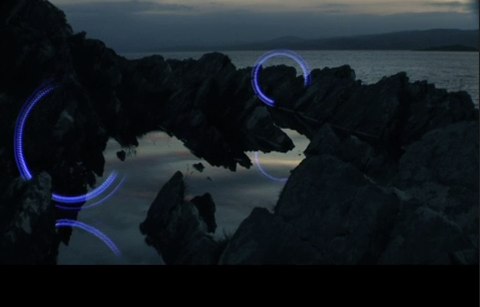
Sophie Clements’ stunning film Evensong films a series of moving light-patterns in Argyll. Mounted on rigs such as spinning wheels, there’s a magic in the way the lights interact with their environment: dancing around poles, reflecting in pools. It’s striking to see light painting such as this in moving, rather than still images.
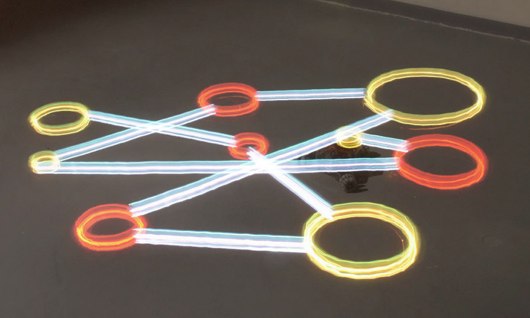
Nils Völker has been buildling a robot for created coloured light drawings. Once the pattern is programmed into it, it trundles around the floor, turning its light on and off as necessary, tracing the pattern whilst a camera takes a long exposure. Whilst not as pretty as Kaalam’s work, there’s something interesting in automating this kind of work. It’s also strange to see this machine at work, as this video testifies: whilst it works, you can’t really see what it’s doing. It only makes sense when viewed as a long-exposure.
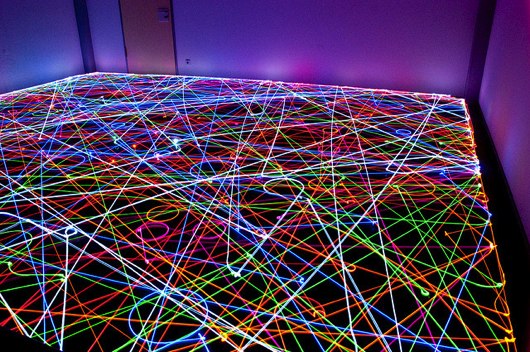
Völker’s robot drew the patterns it was told to. But light painting techniques can also reveal the behaviours of smarter robots. The above picture comes from the Roomba Art group on Flickr – where people upload long exposures of their automated vacuum cleaners having attached lights to them. This image shows seven Roombas – each with a different colour LED – working all at once; you can see their starting points in the middle of the room, and the odd collision. It’s a very pretty remnant of robots at work. The rest of the pool is great, too.
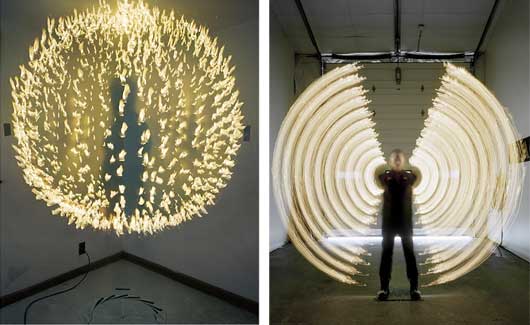
Photos: Light Sphere with Right Arm and Cigarette Lighter and Arcs with Arms and Candles by Caleb Charland
Caleb Charland’s images take a variety of approaches to light painting. Some are multiple exposures; some are long-duration, single exposures. Some are very much about the artist’s presence in the image (albeit in ghostly ways); in others, the artist is largely absent. They’re all lovely, though; I particular like his use of naked flames in his images.
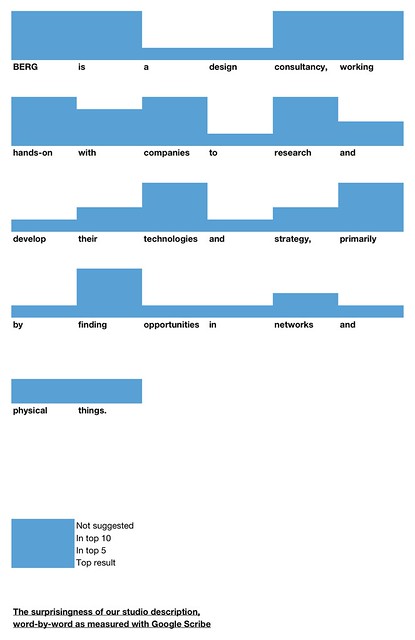
Google Scribe is autocomplete meets word processing. It looks at everything you’ve typed so far, and predicts what you’re going to say next. For example, Scribe believes I am now about to write: they are not the only one who can not afford to pay for the cost of the project is to develop a new generation of protein database.
I feel like I’m connected to the spirit world, except that the spirit world is an amalgam of a billion Internet users and Google’s massive server farm.
What I like about Scribe is that you can see how surprising each word is. If Google can’t predict what you’re about to say, what you’re saying is truly novel.
So:
At the bottom of every page on this website, there’s a little statement about ourselves: BERG is a design consultancy, working hands-on with companies to research and develop their technologies and strategy, primarily by finding opportunities in networks and physical things.
I made a chart of word-by-word surprisingness: given the statement so far, could Scribe predict what would come next?
Here are the results:
I learn that about half of the statement is exactly what Google’s spirit world expects, which goes to show it could be more concise and higher signal-to-noise.
Use this technique to avoid redundancy in speech or writing.
Matt’s going to be giving a talk on “Old Sci-Fi & Little Robots” at this year’s Do Lectures, in a tent in West Wales!
Having been to a previous Do, I’m very jealous. It’s a fantastic event, and all the videos from past Do Lectures are online – it’s a bit like TED but with fewer presidents or rockstars and more mud…