One of the pleasures of being at BERG is the people you get to work with. The core group in the studio is small, so we often work with collaborators on larger projects. They bring something fresh to the mix in the studio, making their own mark both on the work we do and the culture of the space.
Earlier this year, Lei Bramley worked with us – primarily, with Nick – on developing the iPad reader application for Mag+. It was great to have him around.
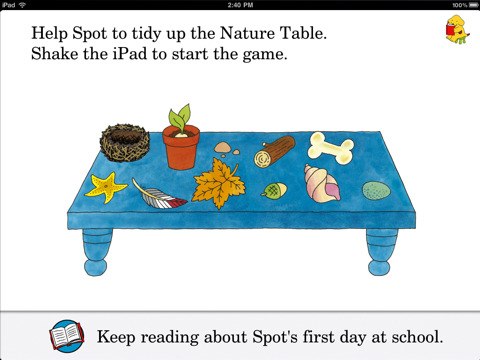
It’s always nice to know what BERG alumni are up to. Lei’s just finished helping Penguin with their iPad version of Spot Goes To School, which looks like an interesting take on what a rich, interactive children’s book can be. You can find out more on the iTunes Store.
Lei told us that “it was a lot of fun, although I have the recurring whistling theme music branded onto my brain!” It’s a really nice product.
One of the things that was easier, writing these notes about the studio back in 2009, was that the room was smaller. There’s something about stewing in each other’s pheromones. You share moods. If the week was tiring, you were all tired. If you had the sherbet fizz of excitement in your belly, you knew that was the collective unconscious of the studio at large.
In August 2010, we’re too big for that. We’re not big by any means! Eight people, a network of experts, and just taken on a ninth – Alex Jarvis is joining us in October! – but big enough for different moods and senses to sit together in the same space.
When three people are buzzing, collectively discovering a new filming technique, you can see the static sparks fly between them and the energy is infectious. Conversely, a feeling of difficulty or defeat when a particular project is crunching can rise like some deep magma upswell and roll around the studio almost tidally before it’s recognised, digested and massaged out.
Mood transmission follows lines of physical proximity, conversations, and collaboration.
Part of the job of gardening a studio – a community of people – is to encourage the right transmissions and tides. By weaving together sources of energy, in reinforcing loops, a collective exuberance may take place.
Exuberance is a period in the development of the brain that lasts until 10 years of age. It is an over-production of connections between neurons, a decade-long acid trip seeing the secret alignments of the universe. During your teenage years, your brain sculpts itself into a mirror of the reality it has chosen to perceive, pruning away possible worlds.
Exuberance is a state only entered into with care. It’s frazzling. We maybe don’t have to use it right now.
We have a lot on at the moment: internal R&D, film-making, design and communications work, ops and infrastructure, the sales pipeline… projects are giant invisible bears that roam around the studio tickling ribs and cracking heads. Recently projects have been colliding, not in a way where that has been affecting the work, but in odd second-order ways: people have to task-switch too much; tasks appear suddenly when they’re urgent instead of being apprehended; the gardening of the studio becomes automatic and unthinking. That needs to be looked at.
When I write these notes, I’m aware that I’m now just one perspective. When I look around, easiness and effort sit side-by-side. This studio has many voices.
What matters now are how different characters refract light differently as illumination moves between them, and how the interference patterns of the waves and rhythms of different projects interacting can be either choppy or smooth. Complexity. I have no ways to understand this. My brain’s picture of reality isn’t yet sculpted like this.
So I’m thinking about ways to manage a small big room instead of a big small room.
All of which feels like growing up a bit.
Autopoiesis is a process whereby a system produces its own organization and maintains and constitutes itself in a space. E.g., a biological cell, a living organism and to some extend a corporation and a society as a whole.
The studio we’re creating together is not only a garden that grows culture, but at the same time garden capable of self-gardening. We sometimes overlook this capacity in humans I think, because of the organ focus we have on the body. There is an organ for thinking. There is an organ for cleaning the blood. There is an organ for digesting the world into particles. These are clearly demarcated. There is also an organ for self-growth, but it isn’t demarcated in the same way. It is distributed into the molecules of every cell in the body. It exists on the organisational plane. So the organs of regulated self-creation in our studio will be psychic and structural, but they have existence none-the-less. I want to be able to spend more time looking for and looking after this organ.
For some reason today, I’m preoccupied with the leylines and gravities and internal terrain of the studio.
12 months
I monitor three budgets: attention; cash; risk. All are flows to be directed. Attention: how many minutes do we have as a studio, any how many can be spent in experimental or undirected ways? Cash: how can cash-flow be managed to build up working capital to invest, versus spend freely to buy more attention to spend? Risk: how tolerant are the attention and cash budgets to delay or failure?
We can direct some flow into the infrastructure of the studio machine: our calcified processes, libraries and knowledge that operate automatically, and give our future attention and cash greater leverage.
In the last 12 months, we’ve consulted on design strategy with Nokia, the BBC, Sitra, Bonnier, Layar, BILD and Absolut. We’ve written articles in Icon and Edge, had press in Wired and Creative Review. We’ve made a movie about RFID, re-invented the magazine with Mag+ — and created a digital magazine publishing platform that excited Apple. We’ve released Michel Thomas,Schooloscope, and BBC Dimensions. We’ve moved premises, built a team, and have significant internal and client projects well underway.
From this, we’re building decent leverage of our activity. The conversations we have with people now are less like client/supplier interactions, and more like figuring out how to start relationships. Good.
Behind the mountains there are mountains, so enjoy the climb. It’s a good feeling to look at the mountain-tops and, even in a little way, know we have room to choose the path.
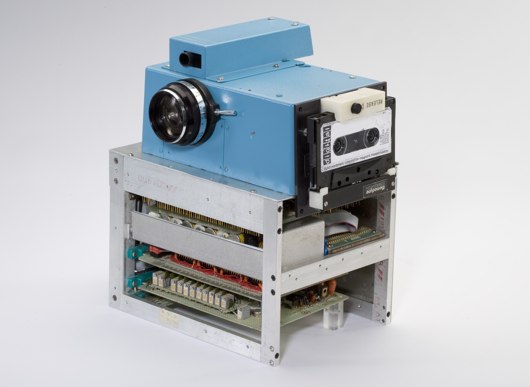
Matt J provided this image of Kodak’s first digital camera, from 1975, and the accompanying story:
It was a camera that didn’t use any film to capture still images – a camera that would capture images using a CCD imager and digitize the captured scene and store the digital info on a standard cassette. It took 23 seconds to record the digitized image to the cassette. The image was viewed by removing the cassette from the camera and placing it in a custom playback device. This playback device incorporated a cassette reader and a specially built frame store. This custom frame store received the data from the tape, interpolated the 100 captured lines to 400 lines, and generated a standard NTSC video signal, which was then sent to a television set.
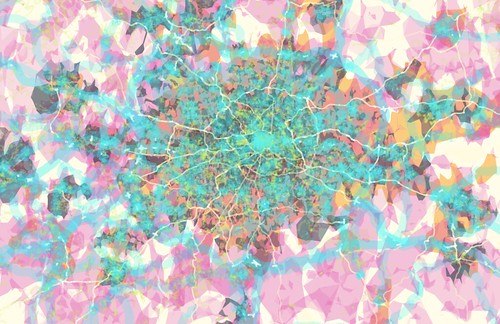
Matt B sent us Anil Bawa-Cavia’s visualisations of Foursquare check-in data for London, Paris and New York. The striking maps (an excerpt of which is displayed above) start by displaying activity across a uniform grid:
In these maps, activity on the Foursquare network is aggregated onto a grid of ‘walkable’ cells (each one 400×400 meters in size) represented by dots. The size of each dot corresponds to the level of activity in that cell. By this process we can see social centers emerge in each city.
Nick pointed out that Epic Win is now on sale. It’s a playful to-do list that turns doing tasks into experience points for an avatar, much as Chore Wars before it. What sets it out for me is just how much value there is in making a functional piece of software – in this case, a to-do list – well-designed and beautiful. It’s fun to use, without getting in the way of the basic task of making lists, and I want to go back to it. It’s worth playing with just for the consistency of its visual design.
Finally, I really liked David Arenou’s “Immersive Rail Shooter”. In it, he takes the standard video-game lightgun game and adds the ability to use the environment for cover, by placing AR tags around a room for the console’s camera to detect. From his site about the project, it appears to be a very much working prototype (as opposed to proof-of-concept video).
What’s really fun for me is that although it uses markers and computer vision to detect the player’s location, the “augmenting” of reality is done not through a camera and a screen – but by changing of the room the player interacts with. All of a sudden, the chair in the real-world becomes cover in the game-world, and so you end up ducking and diving around the living room. No glasses, no holding a mobile phone in front of your face, but the boundary between the game and reality has very definitely been blurred.
Shortly after the launch this week of BBC Dimensions at http://howbigreally.com, it was given a good test of how the system can respond to current events as well as bringing the scale of historical events and places home.
Initially it’s superimposed over the UK, centred on London. When I saw it stretched from the Bay of Biscay, across Britain – to almost the tip of Norway, it gave me real pause. I went and donated to the Disasters Emergency Committee.
About a year ago we did some workshops with the BBC, to look at new ways in which history could be explored and explained using digital media. We came up with 30 or so ideas which got narrowed down to 5 ‘microbriefs’ for possible future prototyping.
One of our favourites from the off was an idea we called “Dimensions”.
From our original concept document:
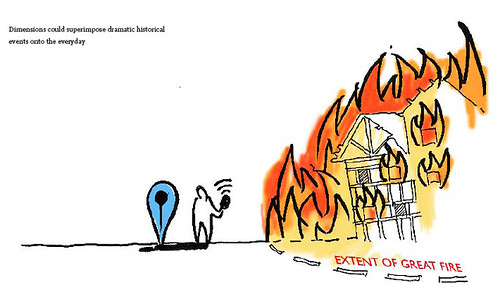
“We want to bring home the human scale of events and places in history. The Apollo 11 Moon walk explored an area smaller than Trafalgar Square; the distance between your WW1 trench and the enemy could only be as much as from your front door to the street corner.
Dimensions is a feature on websites that juxtaposes the size of historical events with your home and neighbourhood. You’re hearing about the span of the base of the Great Pyramids, or the distance of the book depository from JFK, or the extent of the Great Fire of London… Dimensions overlays this map on a satellite view of where you live.”
Earlier this year we began to design and build a public prototype of the BBC Dimensions concept which we’re putting live today.
It lives at http://howbigreally.com and it’ll be available as a trial for the next few months.
Let me give you a little tour.
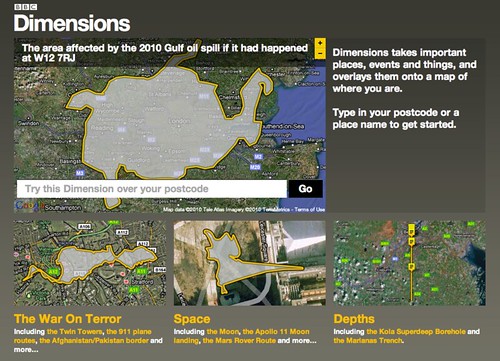
The home page is a collection of what we’ve been calling ‘packages’ – themed collections of ‘Dimensions’. For instance here: ‘The War On Terror, ‘Space’ and ‘Depths’
What’s a Dimension then? Well, basically what it says right there on the homepage: “Dimensions takes important places, events and things, and overlays them onto a map of where you are.”
You can have a play right there and then by entering your postcode or a place name. It understands most things that google maps understands. We’ve built the prototype using google maps, but there’s no reason why it couldn’t work on top of another mapping system eventually.
As we were building the prototype, the BP Deepwater Horizon oil-spill disaster occurred, and you might have seen the excellent visualisation at http://www.ifitwasmyhome.com/ by Andy Lintner.
When we saw that and how well it was received – we knew we were on the right track! Dimensions is a platform to explore a lot more in that vein.
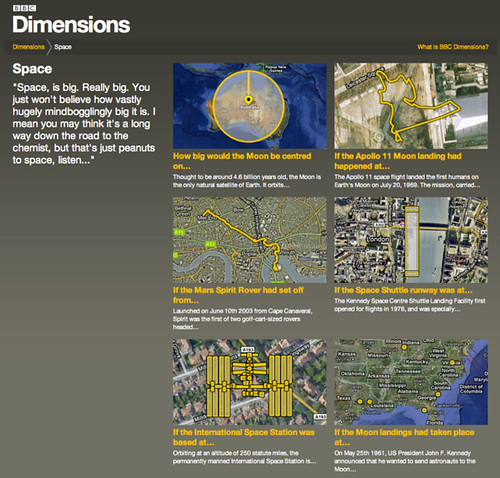
Wandering into the ‘Space’ package reveals a few different types of dimension – sizes, plans, routes.
The routes, such as that taken by the Apollo 11 moonwalkers mentioned in the original concept really can be revealing when juxtaposed on your postcode, or an area you know well…
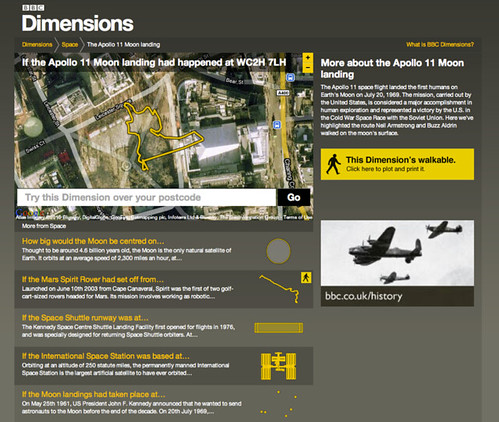
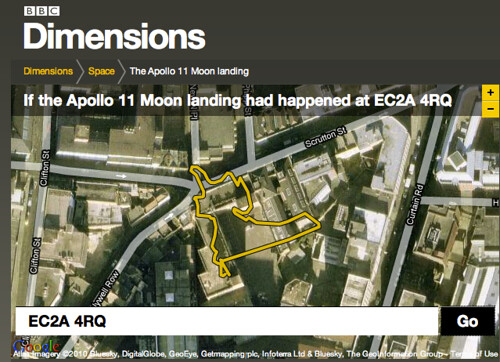
For instance if I type in our studio’s postcode…
I can see that Buzz and Neil would have barely left the building’s carpark…
Some Dimensions let you go a step further, literally – by allowing you to plot a route around your neighbourhood, or perhaps your commute, or perhaps a nearby bit of countryside – so that you can viscerally experience the distances involved.
You point and click on the map to make your walk like so – a little gauge runs along the bottom so you can see how far you have left to plot…
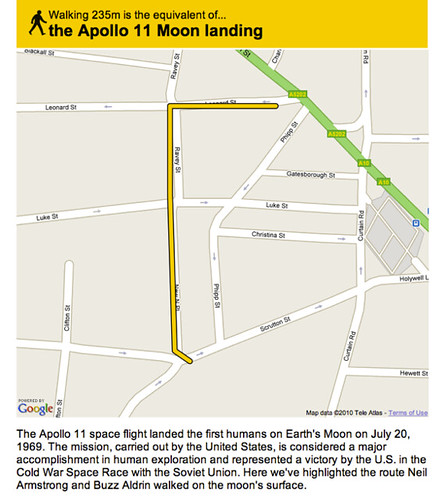
…and when you’re happy with your route you can print out a map to take on your dimensional ramble.
The distance just about takes us from the front-door of our studio to a refreshing pint in one of our locals, The Book Club. Just the thing after a moonwalk.
One of the things I love about it is things like that – where something huge and momentous is made grokkable in the familiar. I also love that that’s all it really does.
It’s a bit like a digital toy – that just does one thing, very clearly (we hope) and delights in doing so.
It’s imagined that if the prototype is successful, it will be integrated into the main BBC site for embedding into history and news storytelling online.
The prototype system that we’ve made allows designers and producers at the BBC to create as many Dimensions as they want to using standard SVG creation tools. It’s also possible that this system could be opened up for local history enthusiasts to create their own dimensions to contribute.
The BBC worked with KeltieCochrane to create the initial content that’s in this prototype, and it was fantastic to see the system we built fill up with their work. My favourite’s The Colossus of Rhodes. Brilliant.
We’ll write some more here about both possible futures and the behind-the-scenes of Dimensions later. In the mean-time, many thanks to Matt Brown, Tom Armitage, Matt Webb, Phil Gyford and Paul Mison who worked on this with me, and Max Gadney for giving us a lovely brief.
More chaff and some wheat from our studio mailing list. Tom’s away on holiday in welsh Wales, so this maybe a little more haphazard than his usual excellent curation.
We found out from David Weinburger that “The ‘points’ by which we measure fonts were adopted in the 18th century. They are 144th of the length of the foot of the king of France at that time.” – which prompted the response in the studio of “Hang on, doesn’t that mean the French king had feet only 2 inches long? Maybe he was a baby.”
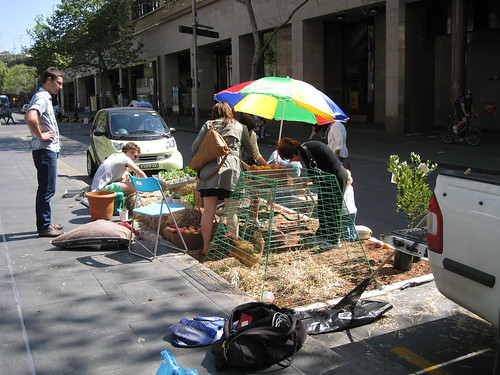
Nick sent the studio this link to the plans that Audi have to turn their cars into mobile wifi hotspots. Maybe he’s dropping hints for a corporate car. Conversely, we’re wondering if we can do anything in the parking spots outside the studio for Park(ing) Day which is just 6 weeks away.
Talking of cities – I’ve been loving Tim Carmody of BERG-favourites Snarkmarket standing in for Jason at Kottke.org. His post on “Cities as Hypertext” is worth a read.
“whenever I read anything about the web rewiring our brains, foretelling immanent disaster, I’ve always thought, geez, people — we live in cities! Our species has evolved to survive in every climate and environment on dry land. Our brains can handle it!
Google Wave was weird, but cheap. Compared to Kin, which likely involved dozens of people and man-months, Wave was likely done by a small team of people. That was their biggest cost! If you’re going to have failures, even visible ones, better cheap and small, that expensive and large.
Outgoing editor Justin McGuirk asked me to write a little about the near-future of digital magazines for Icon #87, in which I talk a bit about challenges of the context they now find themselves in as a media form, as well as things we think we learned during the Mag+ project.
This week’s been buzzing and busy – everybody’s back in the studio after a week of holidays, festivals, and trips to India. That means the studio mailing list has been buzzing again, and so it’s time to take the cream of the links and get them onto the blog.
Matt J found Gearbox, a company making “smart toys” to pair with your smartphone. Their first toy is a ball that rolls the direction you tilt your phone in. They explain:
We are then leveraging the connectivity and computing power of the phone to create a fully interactive experience for the user. Our first app for the ball is Sumo. I throw my ball on a table, you throws yours on the table and then we can try and sumo each others ball off the table. However, while our physical balls are moving there is also an onscreen component with online stats, profiles, damage, powerups and other aspects of gameplay that aren’t possible with a regular remote control toy. For instance, when the balls collide they can sustain “damage” and roll slower or I could get a powerup to reverse your controls for a few seconds.
Aside from the games we produce we are also opening up the APIs for the ball so any app developer with no hardware knowledge can build their own games or applications and bring them to the real world.
Smashing; it’s the open-API that really sets these toys apart from something more constrained, like Sony’s Rolly. And this is only their first product!
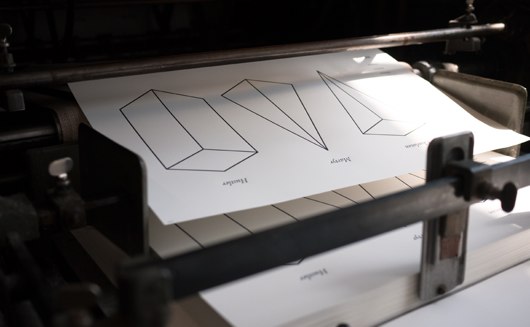
Joey Roth’s ‘Charlatan / Martyr / Huslter‘ poster has been doing the rounds, recently, and with good reason – it’s lovely. But equally lovely is the attention to detail on the webpage selling it. Matt W sent it to our internal list, commenting on how the product page “communicates desire” – the closeups of the type and paper stock, the shot (reproduced above) of copies being stacked. It reinforces that it’s not just an EPS on a piece of paper; it’s a real product, and Roth’s website makes you want it.
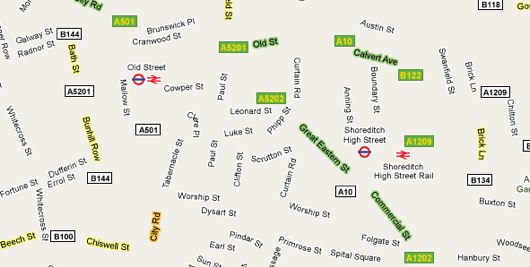
Damon Zucconi’s Fata Morgana is, essentially, Google Maps without the Maps: roads, land, and water are all stripped away leaving just place names and street names. Even zoomed in, as above, the effect persists. Maps made just of names and streets aren’t a new thing – but there’s a strange juxtaposition in seeing them in slippy, interactive javascript form.
Here’s a short demonstration of an official version of The Settlers of Catan for Microsoft’s Surface. It’s a little underwhelming – very literal in some of its metaphors. That said, I loved the interaction between physical tokens and the board – in particular, the way the “visor” has an X-ray effect on cards underneath it. By making it a very realistic – and carefully masked – X-ray effect, the metaphor actually holds up better. It’s very much an understanding of the Surface as a Magic Table rather than a big window.
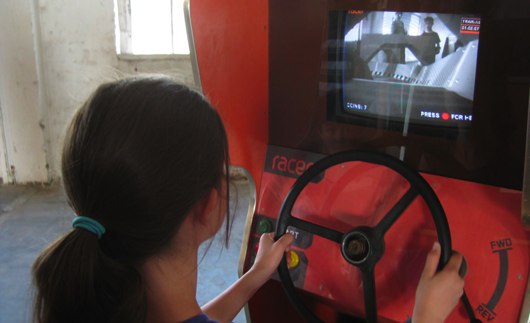
And finally – this is Racer. An old arcade cabinet; a remote control car on a small circuit; a remote camera, and timing circuitry. Put them together and you’ve got this charming and effective game. A tiny, remote-control version of C’était un Rendez-vous, if you like. This video of it in action is great – alas, I couldn’t embed it, so I hope the link suffices.
I was lucky enough to be invited to take part in the Wonderlab a few weeks ago. The official site described it like so:
[An event that brings] together some of the smartest creatives from the digital, gaming, theatre and performance fields, to spend three days exploring where digital tools and the ethos of play will take us next.
Ever since I got back from it, though I’ve mainly been asked what the Lab actually was.
Now that I’ve decompressed from the intensity of those three days, it’s easier to both write about the event itself, and answer that question. The short video above may provide some hints, but might also just look like a bunch of grownups talking and playing games. It deserves a more detailed explanation.
The Lab was a small event, with 10 invited participants from a variety of backgrounds – performers, artists, designers, technical types. We all were, however, connected by our interest in play or games. Given the tiny size, and that it was invite-only, it doesn’t feel fair to label it as a conference. And though there was a great deal of freedom in our discussions and sessions over the three days, the Lab differed from a conference in that a definite outcome was required: as a group, we had to present “our findings” – whatever they’d turn out to be – in the format of a card game.
You could have called it a three-day game-design workshop, except it’s not entirely fair to call it a workshop, either: the format of our conclusion may have been dictated, but what conclusion we were aiming for was not clear to begin with. We had a trajectory, the event shaped by tiny, five-minute talks from each of the participants and a range of guest speakers, all talking about something that “blew their mind”, and leading into subsequent discussion. We had a few sessions where we raised topics we felt relevant to the discussion of play and games, and as the Lab went on, definite themes emerged. And then, we would have to stop talking, and make things – tiny, prototype games to prove a point; collaborative rulsets in a session of Nomic; slowly putting what we “thought” and “believed” into practice. And then, from a practical session, back to discussion and analysis.
The term “Lab” eventually proved to be the most succinct explanation of affairs. It was a space that encouraged both exploration and experimentation, not favouring one of the other, and definitely emphasising the value of thinking through making. By the end of the three days, we’d designed about two-and-a-half games each, and explored countless others. Nothing focuses the mind like having to put your discoveries and beliefs into physical, playable form.
The Lab fostered a growing literacy of games, considering “literacy” as Alan Kay did – the ability to read and write in a given medium. Early on, we played a simple parlour game called Chairs: the goal being to stop a slowly walking player from sitting down on the last available chair by moving between chairs yourselves. It’s a simple game, and yet as a group, we were terrible at it. But after the initial burst of hilarity, we took it apart: what’s going on, why are we failing, what are the simple guidelines to ensure success. We were still lousy with our newly considered perspective – and I would love to build an AI simulation just to prove how dumb you can play to win the game – but we were beginning to understand our lousiness. And thus the Lab continued: talks, discussions, or games would be presented, taken apart, put back together. I valued being asked to prove or embody a belief; the test was not to succeed, but merely to try.
What did I actually get out of it that I can explain in a concrete sense?
One overriding theme was the ethics of game-design. It’s a huge topic, especially in this post-Jesse-Schell universe, and we explored it very thoroughly in some of the sessions. By the end, we’d designed both a game you could only lose, and a game where everybody would win. We created rules that were, in the real world, entirely unethical, but within the closed system of the game we were playing not only ethical but effectively irrelevant. We considered ethics of structured, rule-based play – games themselves – versus the ongoing act of unstructured play.
For someone so interested in games as systemic media (to quote Eric Zimmerman), I was surprised by how enamoured I became in the performative aspects of games. That was no doubt in part down to the insight brought to our sessions by the numerous particiapnts with performance backgrounds. In my notes, I wrote
Games don’t have to be performance-based, but games that don’t afford performance are weaker for it
This is, I guess, what Matt J has previously described as toyetics – it’s the fun you can have with a system, the ways it affords non-structured play, the ways it encourages you to interact with other people in a social capacity. It’s the fun you can have just playing. Games aren’t just rules – they’re rules you can play with, and the best games often afford the best play.
I also finally became convinced of the value of MDA [pdf] as a framework for understanding games; previously, it had never really clicked with me. In particular, I came to appreciate the value of rules and Mechanics emerging from Dynamics – often in the form of exploration or improvisation. If the act of play isn’t fun, or challenging, or interesting, why should a game that demands non-fun actions be any good at all? Guest speaker Tassos Stevens put this much better than I currently can in his wonderful short talk, Make Believe:
Game arises from play. A ruleset crystallises a set of actions distilled from an experience of play. That crystal can be popped in your pocket to be played with again and again, any time, any place, with anyone entranced by its sparkle. It gets chipped and scratched, then rubbed and polished… the very best thing about it is that if we want to, we can smash it up and grind it into paste to make believe anew.
What we were doing at the lab was learning how to make games arise.
The game we eventually presented, to a small invited audience, was Couple Up: a site-specific parlour-game, based on getting the guests invited at the final session from one room (where they were socialising) to another (where there was booze). It used cards as a social token, but the game was played in conversations between players. From the video above, it might seem slight, and whimsical; it’s certainly a little bit broken, and needs some revisions. But at it’s core are a few things we wanted to explore: designing ethical games; designing games that forced you to learn to “read” them; games that afford performance; games that exploit hidden knowledge (both on the part of the players and game-makers. That explorations happened not only in the making, but also in watching our guests play the game, and subsequently discuss it with us afterwards.
The standard of discussion and quality of the participants and speakers throughout the lab was fantastic. The fact we were reigned-in, asked to stop taking and start explaining ourselves through making, was an important challenge, and a visible reminder of the value of thinking through making. And, of course, though our subject matter was play through the lens of games of all forms, I can already see the ways many of the lessons I learned apply to my work in design.
Some of the output of the Lab was very immediate – new colleagues, new ideas to take away. Some of it is lodged into my brain, not taking form right now, but burning away, and will no doubt nag me for the rest of the year. It acted like so many of my favourite conferences – not a reminder of things that I’ve failed to do in my work, or things that have to change immediately, but things to be thinking about in the long term, and to be incorporated into future output. Not One Big Idea, but a hundred ideas, percolating away, growing and mutating until they’re ready to use. I’ll be making use of what I learned in so many projects, and so much work, from here on out.
As such: it was a privilege to take part; thanks to Margaret, Miranda, Alex, and everyone at Hide & Seek who organised the event, not to mention LIFT and the Jerwood Foundation for their support – and, most of all, to the other participants, who all brought something wonderful to the mix.
(You can see all the participants’ short talks, and a succession of more general videos, at the Wonderlab 2010 Youtube channel. My own five-minute talk, on the German boardgame Waldschattenspiel, is here)
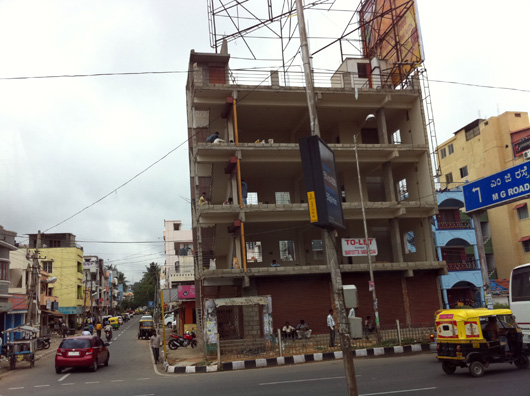
I accompanied the Prime Minister’s trade mission to India last week, part of the business delegation visiting Bangalore and Delhi to meet with companies and government. Alongside the business delegation were sports, education, local government and technology.
What can I say? To see even a glimpse of India’s colossal and vibrant democracy was invigorating. And it was only a glimpse: the two days were tightly managed, and I saw mostly board rooms in the Ministry of Commerce and the futuristic landscape of the Infosys campus. My experience of India was a ribbon seen from a coach going between venues.
Watching the discussions between ministers and CEOs was like watching a slow ballet between planets. India will lift hundreds of millions out of poverty before the decade is done, and the infrastructure required needs engineering and financing (to mention just one topic of conversation). It’s always been a fascination of mine how individual action integrates into society-wide change, and it’s good to have a brief look at one mechanism and one corner of that puzzle.
I’ve returned with a new picture of India. The level of entrepreneurialism, the careful attacks on large problems, the energy… it can only be good for the culture of the UK have closer links with this. I don’t know how I or we can be involved, but I’ve made a few connections and will do my best.
Of course being so close to government was good. David Cameron took a number of ministers, and there are particular issues close to my heart: how the Internet start-ups and small businesses in London can somehow ignite into a stronger community, and contribute to the recovery. I asked for thoughts and advice, and I’ve come back with a few ideas about what could help there.
And the conversations with various CEOs etc: it’s not often you have this kind of access if you’re not in that orbit, and in as much as you can learn anything in snatched conversations between events and on coaches, I feel like I have a much better understanding of that world.
On a personal note, it was a joy to see India and meet people there. I’ve never visited although I’m half Indian myself (my mother is East African Indian, and moved from Nairobi to London in 1970). So for me there was a happy and proud confusion of personal and racial identity that permeated the entire trip.
I’m going to follow up on a few conversations this week. And also get a massage to try and fix my back, which hasn’t forgiven me for the amount of time I’ve put it in aeroplane seats recently.